
Lifting & Elasticity
Ulthera vs. Thermage: Sagging Contours or Thin Skin, Which Lifting Fits?
Why Ulthera is considered for sagging contours and Thermage for thin skin elasticity, how the two differ, and what to consider when combining them.

Dr. Dong Min LEE MD · RUBY DERMATOLOGY
· 4 min read
"Every time I look in the mirror, my jawline feels blurred and my lower cheek jowls seem to droop, but my friend swears by Thermage for firm skin—should I get that instead?" This is one of the most common dilemmas patients share during consultations. While Ulthera and Thermage stand as the two pillars of anti-aging lifting treatments, choosing between them can be confusing.
By understanding how their underlying energy sources and target dermal depths differ, you can find the appropriate solution tailored to your facial structure.
3-Line Key Takeaways (TL;DR)
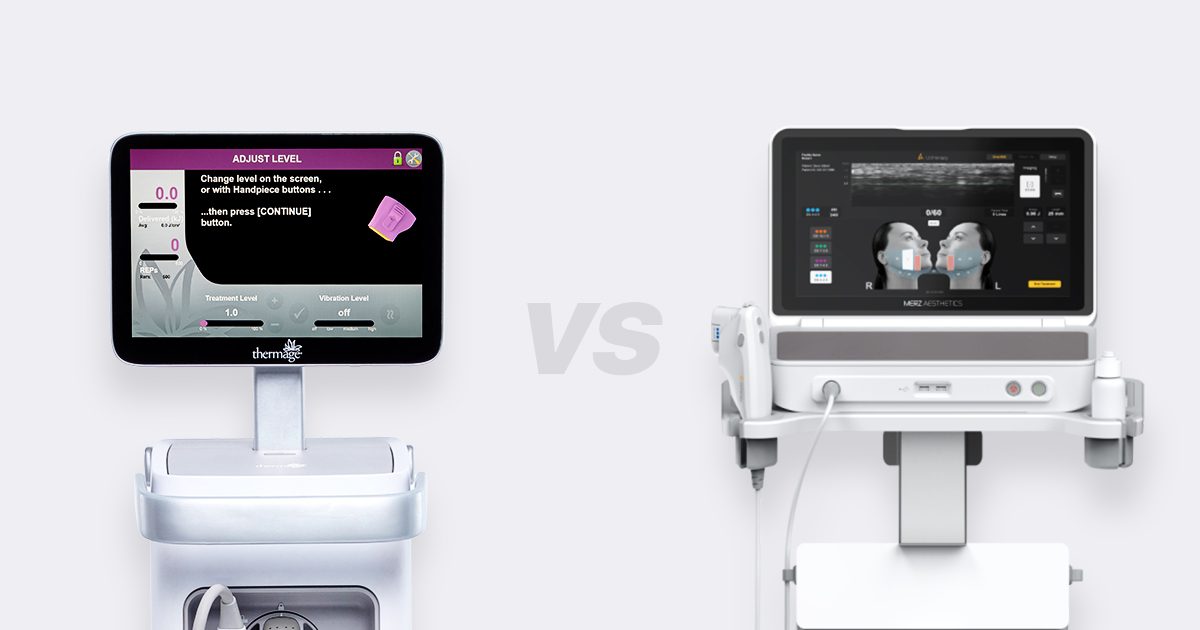
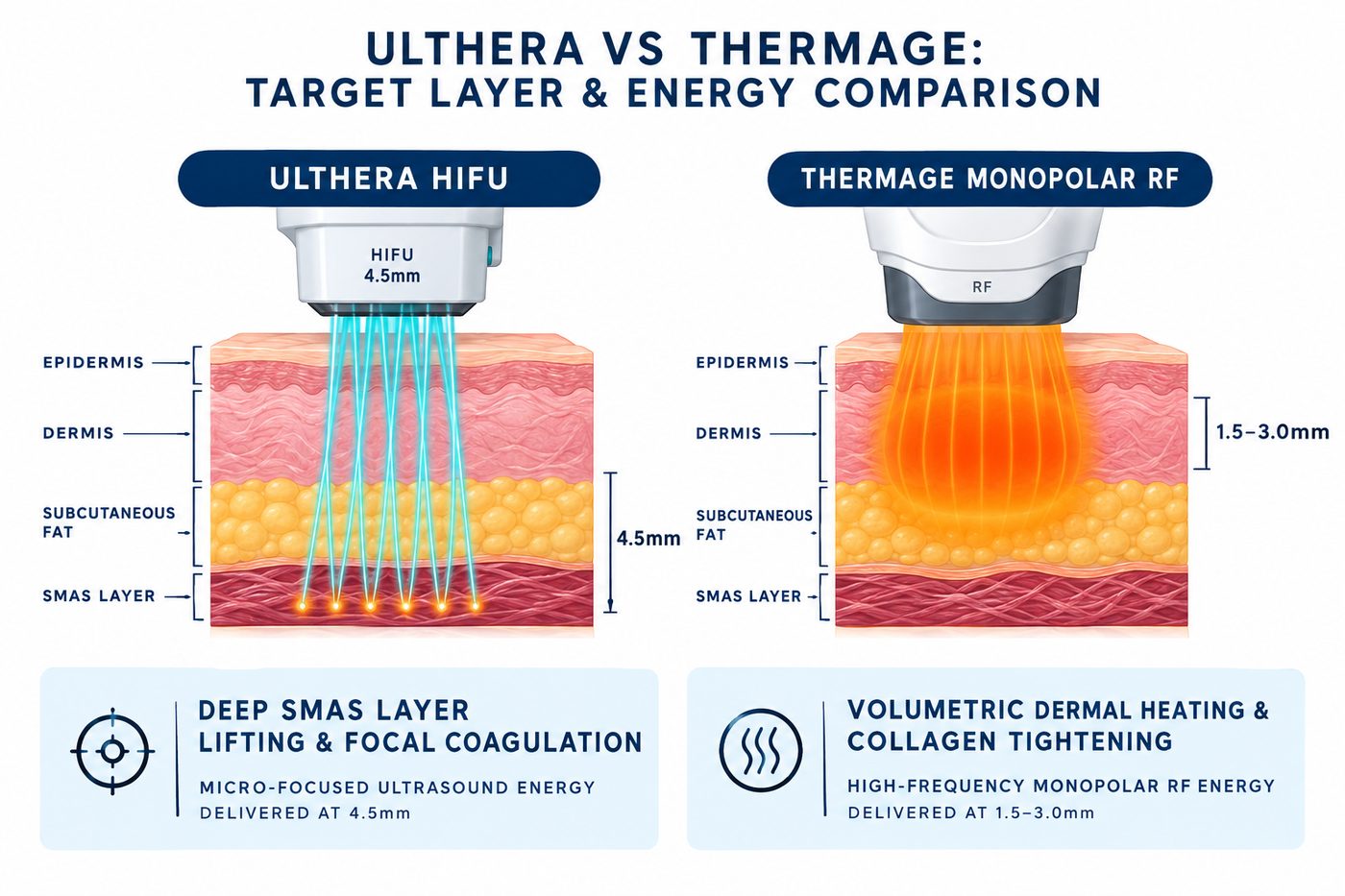
- Mechanistic Difference: Ulthera uses High-Intensity Focused Ultrasound (HIFU) to target the deep SMAS layer for lifting, while Thermage FLX utilizes Monopolar Radiofrequency (RF) to heat the entire dermis for surface tightening.
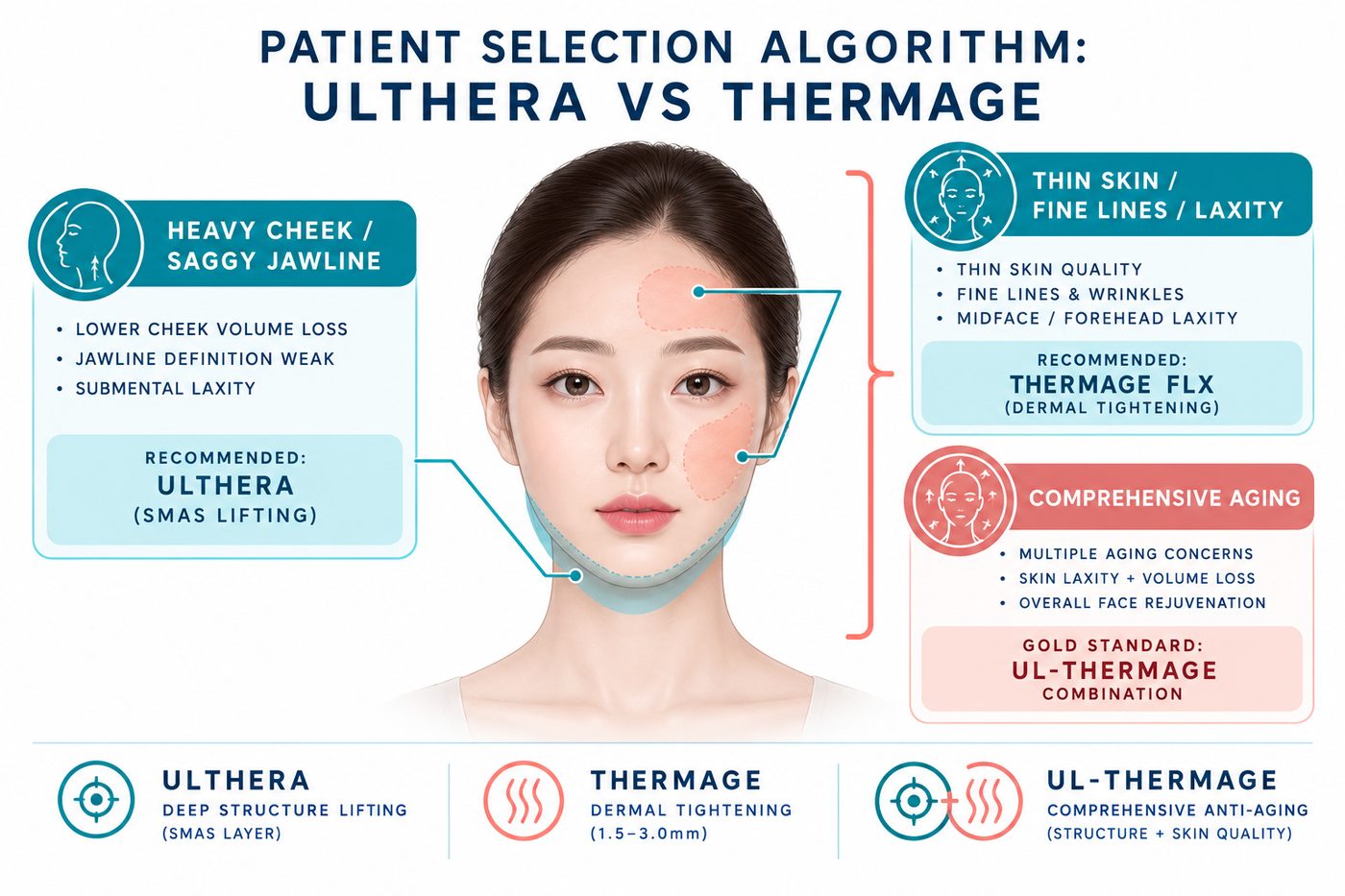
- Selection Criteria: Ulthera is suitable for thick skin with sagging jawlines or double chins; Thermage is commonly used for thin skin with fine lines, enlarged pores, or loss of elasticity.
- Synergy Combination: For simultaneous deep lifting and dermal tightening, the combined "Ul-Thermage" protocol offers the gold-standard comprehensive approach.
Ulthera vs. Thermage: How Their Energy Profiles Differ
The fundamental distinction lies in the energy modality and target penetration depth.
Ulthera (HIFU, High-Intensity Focused Ultrasound)
Focuses ultrasound energy to create micro-thermal coagulation points (TCPs) at precise depths. Reaching the deep SMAS (fascia) layer ($4.5\text{ mm}$), it induces tissue contraction to deliver a powerful non-surgical lifting effect on sagging structures.
Thermage FLX (Monopolar RF, Monopolar Radiofrequency)
Delivers uniform radiofrequency heat throughout the epidermal and dermal layers ($1.5\text{–}3.0\text{ mm}$). It contracts existing collagen fibers and stimulates new neocollagenesis, tightening fine lines and increasing dermal density.
Personal Assessment (Who Benefits Most?)
Recommended Candidates for Ulthera
- Patients with moderate facial subcutaneous fat experiencing jawline sagging due to gravity.
- Individuals concerned about double chins, marionette lines, or bulldog jowls.
- Patients seeking defined, sculpted facial contours and structural lifting.
Recommended Candidates for Thermage
- Patients with thin skin or minimal subcutaneous fat who fear cheek hollows from HIFU.
- Individuals with fine crepey wrinkles, sagging skin texture, or enlarged pores.
- Patients seeking overall skin density, elasticity, and surface firmness.
Comparative Analysis: Ulthera vs. Thermage FLX
| Parameter | Ulthera | Thermage FLX |
|---|---|---|
| Energy Modality | High-Intensity Focused Ultrasound (HIFU) | Monopolar Radiofrequency (RF) |
| Primary Target Depth | SMAS Layer ($4.5\text{ mm}$) | Entire Dermis ($1.5\text{–}3.0\text{ mm}$) |
| Core Effect | Contour lifting & double chin reduction | Surface tightening, pore & fine line refinement |
| Suitable Skin Profile | Fatty skin with structural sagging | Thin skin with fine wrinkling & laxity |
| Key Safety Tech | DeepSEE™ Real-time Ultrasound Imaging | AccuREP™ Real-time Impedance Tuning |
Clinical Safety Precautions: Preventing Hollows & Burns
- Ulthera Precautions (Avoiding Volume Loss): Excessive energy delivered into fat-deficient zones (such as under the cheekbones) can cause subcutaneous fat atrophy. Real-time visualization via DeepSEE™ ensures precise layer mapping to safeguard delicate areas.
- Thermage Precautions (Preventing Thermal Burns): Inadequate cooling gas dispersion or incomplete tip contact can cause surface burns. Authentic single-use tips and precise handpiece contact techniques are important.
Longevity and Treatment Schedules
- Ulthera: Lifting effects peak around 2 to 3 months post-treatment as collagen remodeling matures, with contour improvements lasting 12 to 18 months.
- Thermage FLX: Immediate post-procedure firmness is followed by progressive collagen synthesis over 2 to 6 months; annual maintenance sessions are recommended.
Combination Treatment: 'Ul-Thermage'
Patients often present with mixed aging patterns—such as sagging jawlines alongside thin, fat-deficient cheek skin. In these cases, the combined Ul-Thermage protocol delivers targeted outcomes:
Ulthera Layer: Focuses on the jawline, submental double chin, and jowls to lift deep structural layers.
Thermage Layer: Focuses on mid-chews, periorbital zones, and the forehead to dense up dermal collagen without volume loss.
Clinical Insights & Practitioner Notes (Dr. LEE Dongmin)
Rather than debating which device is "superior," the key to successful rejuvenation lies in diagnosing which skin layer requires which energy type.
Prior to treatment, I measure dermal thickness, fat distribution, and tissue elasticity. During Ulthera procedures, I utilize real-time DeepSEE™ monitoring to visualize the SMAS layer across $1.5\text{ mm}$, $3.0\text{ mm}$, and $4.5\text{ mm}$ transducers, employing a custom vector design that strictly avoids volume-deficient zones. For Thermage treatments, I monitor real-time impedance feedback to maintain effective therapeutic temperatures—minimizing patient discomfort while enhancing collagen remodeling.
Aftercare and Post-Treatment Guidelines
Immediate Post-Procedure Response: Deep aching sensations may persist for a few days after Ulthera; transient erythema and mild warmth typically resolve within 1 to 2 hours following Thermage.
Post-Care: Wash with lukewarm water for the first week to support thermal regeneration pathways; maintain diligent hydration and broad-spectrum sun protection.
This article provides general medical information and does not replace individual diagnosis or treatment. Effects, recovery time and side effects can differ with skin condition and constitution, so please decide on any procedure after consulting a doctor directly.