
Pores & Scars
Butterfly-Zone Pores and Acne Scars: Potenza CP Pumping Tip Treatment
Causes of enlarged pores and depressed acne scars in the butterfly zone, how Potenza with the CP pumping tip works, and recovery and aftercare.

Dr. Jung HUH MD · RUBY DERMATOLOGY
· 5 min read
Hello, I am Doctor HUH Jung, representative director of Ruby Dermatology Clinic, focusing on treatments that enhance skin's natural structural health and self-regenerative capacity.
The pores in my butterfly zone around my nose and cheeks are enlarged, and makeup keeps caking inside them. I hesitate to get acne scar treatments because I'm afraid the pain will be too severe and scabs will form, making daily life impossible.
This is the most frequent concern shared by patients visiting the consultation room for enlarged pores and depressed acne scars.
We must move away from methods like traditional fractional lasers that abrade the entire epidermis, forcing patients to endure prolonged recovery periods and redness. The Potenza CP Pumping Tip approach—which protects the skin surface while delivering radiofrequency (RF) energy exclusively to the dermal layer and evenly pushing skinboosters deep into the skin—is becoming the new standard in pore and scar treatment.
3-Line Key Takeaways
- Causes of Pore and Scar Formation: They occur due to reduced elasticity caused by decreased collagen in the dermal layer, increased sebum secretion, and fibrous bands contracted after acne inflammation that pull the skin downward.
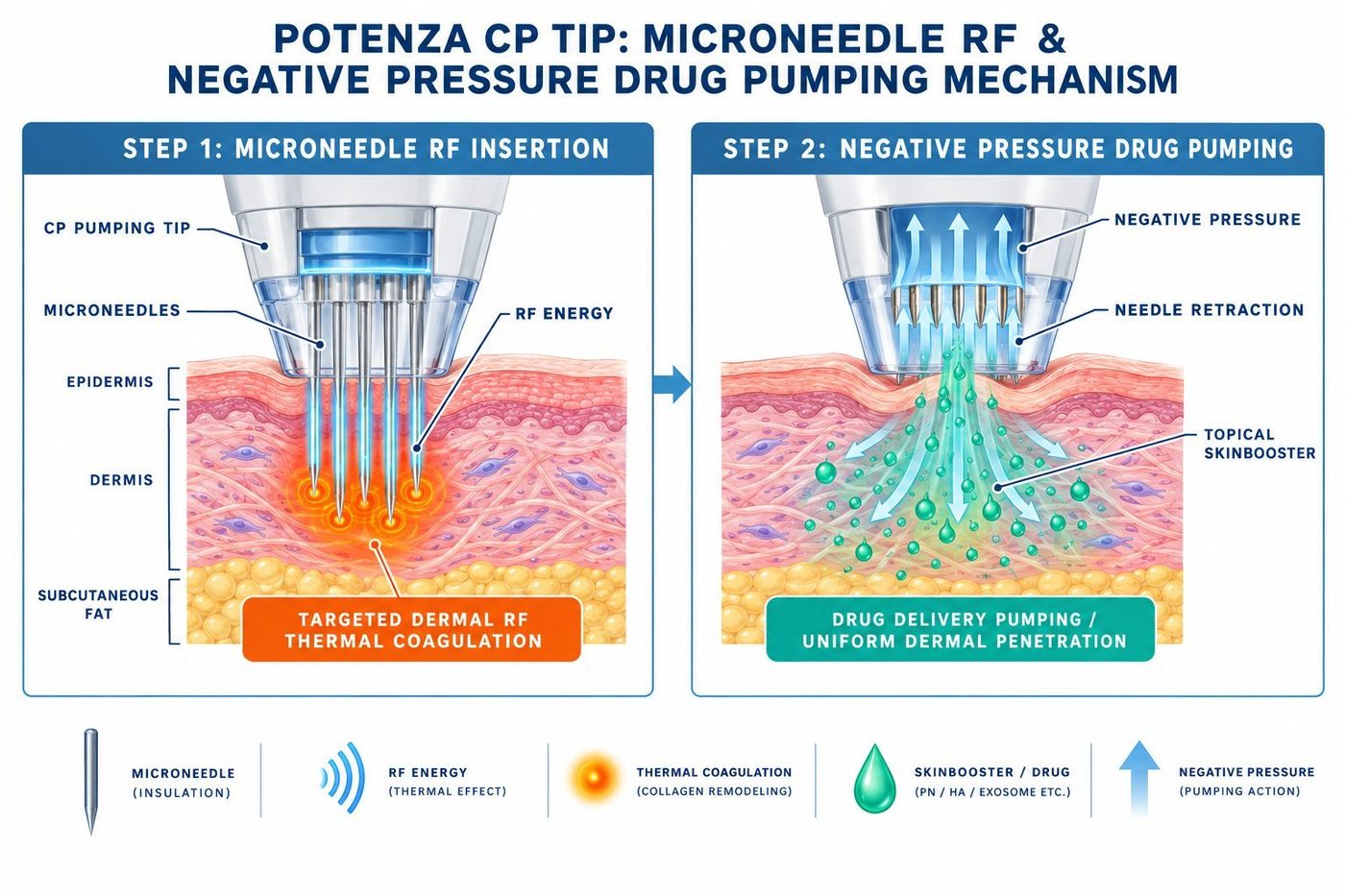
- Potenza CP Pumping Tip Principle: It delivers radiofrequency energy when the microneedles insert, and utilizes the negative pressure generated upon needle retraction to precisely infuse skinbooster medication into the dermal layer.
- Complex Matching Synergy: Combining skinboosters like Juvelook, Rejuran, or exosomes with the CP tip smoothly induces dermal collagen regeneration, creating a smooth skin texture without epidermal damage.
Why Potenza CP Tip Over Fractional Lasers? Anatomical Mechanism of Action
Pore enlargement and depressed scars occur when the collagen and elastin network collapses in the dermal layer rather than the epidermis.
Microneedling RF Minimizing Epidermal Damage: Insulated and non-insulated ultra-fine needles pass through the epidermis to penetrate directly into the dermal layer, subsequently emitting radiofrequency energy. Because thermal damage to the epidermis is minimal, the risk of post-inflammatory hyperpigmentation (PIH)—a common laser side effect—is reduced.
Pneumatic Injection Using Air Pressure (CP Pumping System): The Potenza CP (Pump) tip momentarily controls air pressure the exact moment the microneedles retract. Through this negative pressure action, active topical medications applied to the skin surface are evenly infused down to the lower dermis without loss.
Potenza CP Tip Target Candidates and Indications
May Be Suitable For
- Individuals whose pores around the butterfly zone (nose, cheeks) are stretched horizontally or vertically, causing makeup to continuously cake.
- Those with uneven skin texture due to remaining depressed scars (boxcar, rolling scars) from acne sequelae.
- Anyone who finds prolonged downtime like scabs or redness burdensome and requires rapid return to daily life.
Comparison: Potenza CP Tip vs. Conventional Scar Lasers
| Category | Conventional Fractional Laser (CO2 / Er:YAG) | Potenza CP Pumping Tip (Microneedling RF + Drug) |
|---|---|---|
| Main Energy Source | Ablative lasers that abrade the epidermis | Dermal-targeted microneedle radiofrequency (RF) |
| Degree of Epidermal Damage | Scabs and oozing caused by full epidermal ablation | Minimized epidermal damage, leaving only micro-needle marks |
| Drug Delivery Capacity | Topical application method (low dermal penetration rate) | enhances dermal drug penetration rate via negative pressure pumping tip |
| Pain and Downtime | High pain; long, clear recovery period of 5–7+ days | Alleviated pain; swift recovery within 1–2 days of light redness |
| Pigmentation Risk | PIH risk exists post-procedure due to Asian skin characteristics | Lower risk of pigmentation and side effects |
Treatment Intervals and Recovery Period
- Recommended Treatment Interval: For pore and scar improvement, a basic protocol of 3 to 5+ sessions spaced 3 to 4 weeks apart is recommended.
- Recovery Period: Mild erythema (redness) and warmth may occur on the treatment day, but they naturally resolve within 24 to 48 hours, allowing light makeup starting the next day.
Conquering Pores and Scars: 'Potenza Juvelook Pumping' Synergy Combination
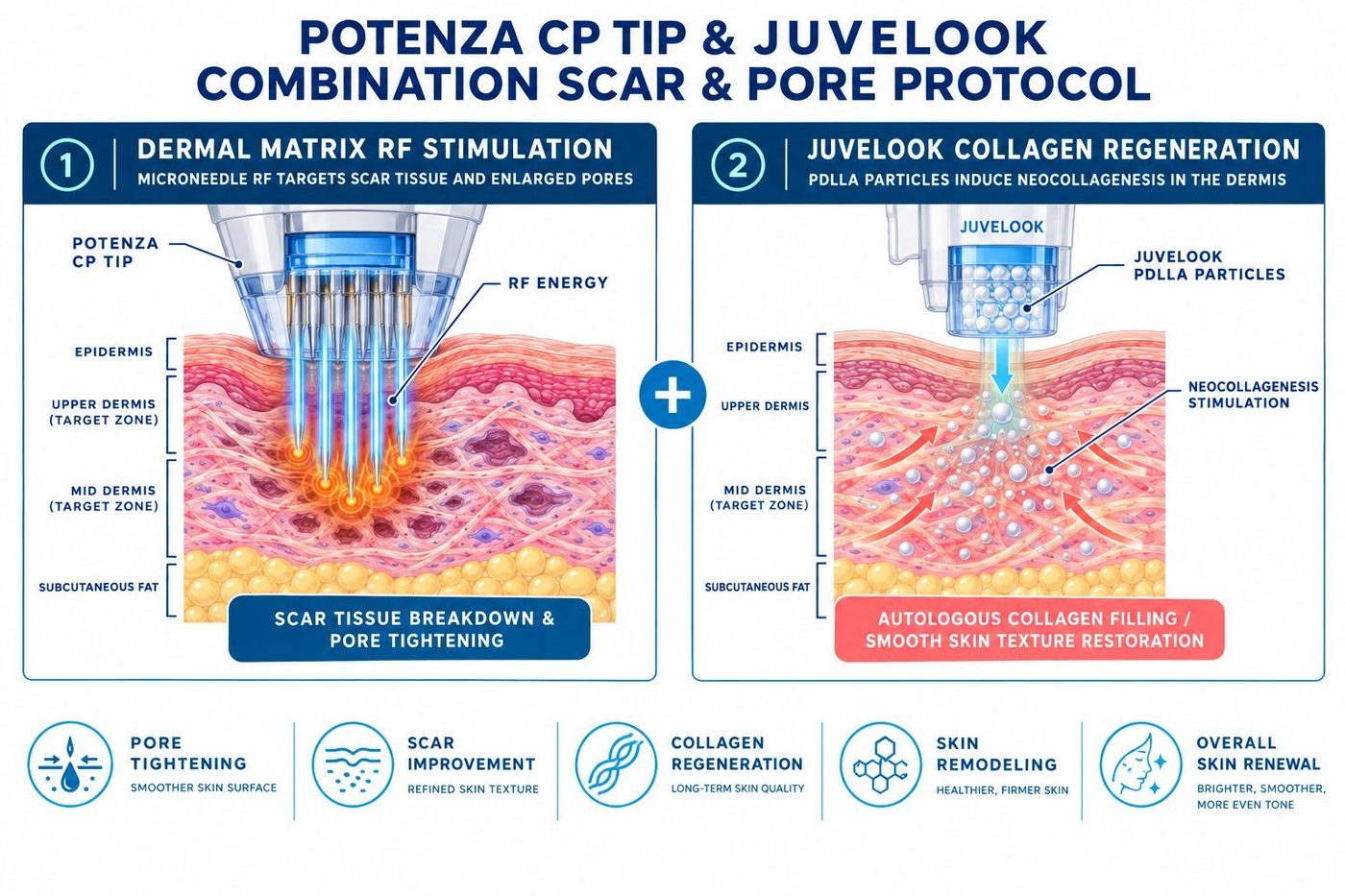
- Potenza CP Tip + Juvelook: Primary thermal coagulation points are formed in the dermis via radiofrequency stimulation, and Juvelook particles are infused into the dermal layer using the pumping power of the CP tip. The PDLLA component of Juvelook induces autologous collagen over several months, enhancing the lifting effect of depressed scars.
- Potenza CP Tip + Exosome / Rejuran: When inflammatory acne marks remain or the skin barrier is weakened, regenerative components are delivered to achieve pore reduction and skin reconstruction simultaneously.
Clinical Insights & Practitioner Notes (Doctor HUH Jung)
The success or failure of pore and acne scar treatment depends on details: setting needle depth and RF energy density meticulously to match pore morphology (icepick, boxcar, rolling types) and dermal layer thickness.
Prior to treatment, I measure regional dermal thickness and pore depth using skin diagnostic devices. For thinner skin around the eyes or temples, I adjust the depth shallowly, whereas for the butterfly zone where pores and scars concentrate, I apply a '3D Multi-Depth Targeting' method varying depths across multiple stages. By delicately adjusting and infusing Juvelook hydration volumes into this process, we reduce pain and redness while rapidly completing a smooth, porcelain skin texture.
Precautions Before & After Treatment
- Ample Moisture and Hydration Care: Apply generous amounts of moisturizing and regenerative creams morning and night to facilitate smooth dermal collagen remodeling post-treatment.
- Sunscreen is Mandatory: To protect regenerating skin from UV stimulation, apply broad-spectrum sunscreen of SPF 50+ or higher diligently when going outdoors.
- Avoid Irritating Scrubs: Refrain from using AHA/BHA chemical exfoliants or granular scrubs for about a week post-treatment, and cleanse the skin gently.
This article provides general medical information and does not replace individual diagnosis or treatment. Effects, recovery time and side effects can differ with skin condition and constitution, so please decide on any procedure after consulting a doctor directly.