
Pigmentation
Why Melasma and Spots Darken When Over-Stimulated, and Where Pico Toning Fits
Why aggressive laser heat can worsen melasma, how pico toning works, combination care options, and pre- and post-treatment precautions.

Dr. Dong Min LEE MD · RUBY DERMATOLOGY
· 4 min read
Hello, I am Doctor LEE Dongmin of Ruby Dermatology Clinic, helping you rediscover the clear, healthy radiance inherent in your skin through delicate medical care.
I received laser toning more than 10 times, but my melasma actually got darker and the borders became messy.
This is one of the most frequent things I hear from patients who visit the dermatology clinic struggling with skin irritation and rebound post-inflammatory hyperpigmentation (PIH) after undergoing pigment treatments.
Pigment conditions like melasma and blemishes cannot be resolved simply by blasting them strongly with lasers as if breaking a hard wall. This is why a Pico Toning approach is necessary—selectively and minutely shattering only the melanin pigmentation without irritating the skin barrier and epidermal layer.
3-Line Key Takeaways
- Why Melasma Darkens: Excessive laser heat stimulation or strong friction stimulates melanocytes (pigment-forming cells), triggering rebound post-inflammatory hyperpigmentation (PIH) that expels even more melanin.
- Core Principle of Pico Toning: Minimizes thermal damage using extremely short exposure times in picosecond (one trillionth of a second) units, breaking down pigment into ultra-fine particles via vibration energy for rapid excretion.
- Complex Regenerative Schema: Combining LDM ultrasound, Rejuran/skinboosters, and barrier recovery care to stabilize pigment cells allows you to work toward a more even skin tone while reducing the risk of side effects.
Anatomical Reasons Why Melasma Darkens After Conventional Toning
Melasma is not merely a superficial pigment; it is a complex condition intertwined with epidermal-dermal basement membrane damage, dermal vascular proliferation, and chronic inflammation.
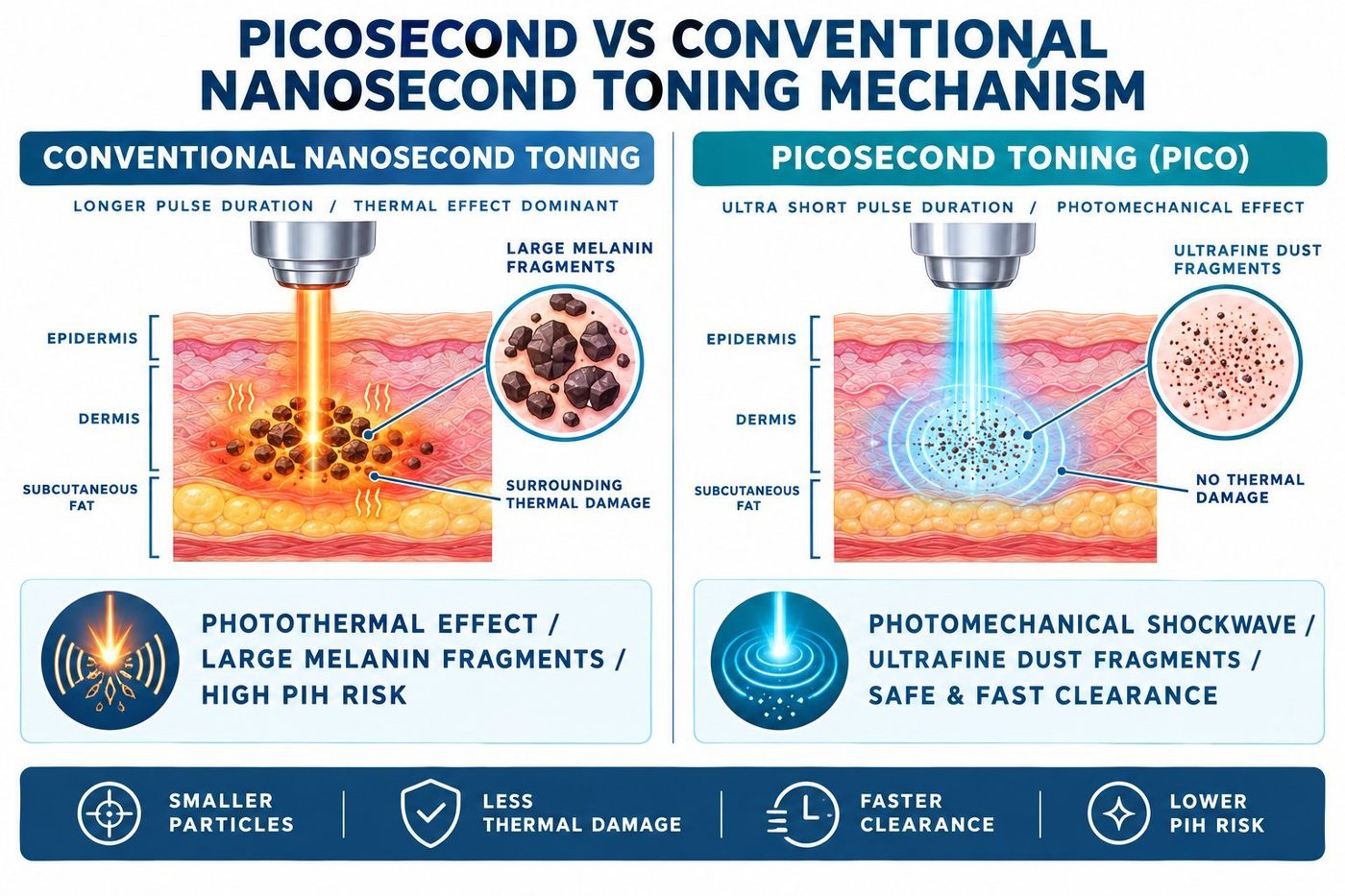
Limitations of Conventional Nano-Second Toning: Traditional laser toning delivers thermal energy in nanosecond (one billionth of a second) units. When laser output is overly strong or repetitive heat accumulates, melanocytes perceive it as an "attack," reactively exploding melanin production.
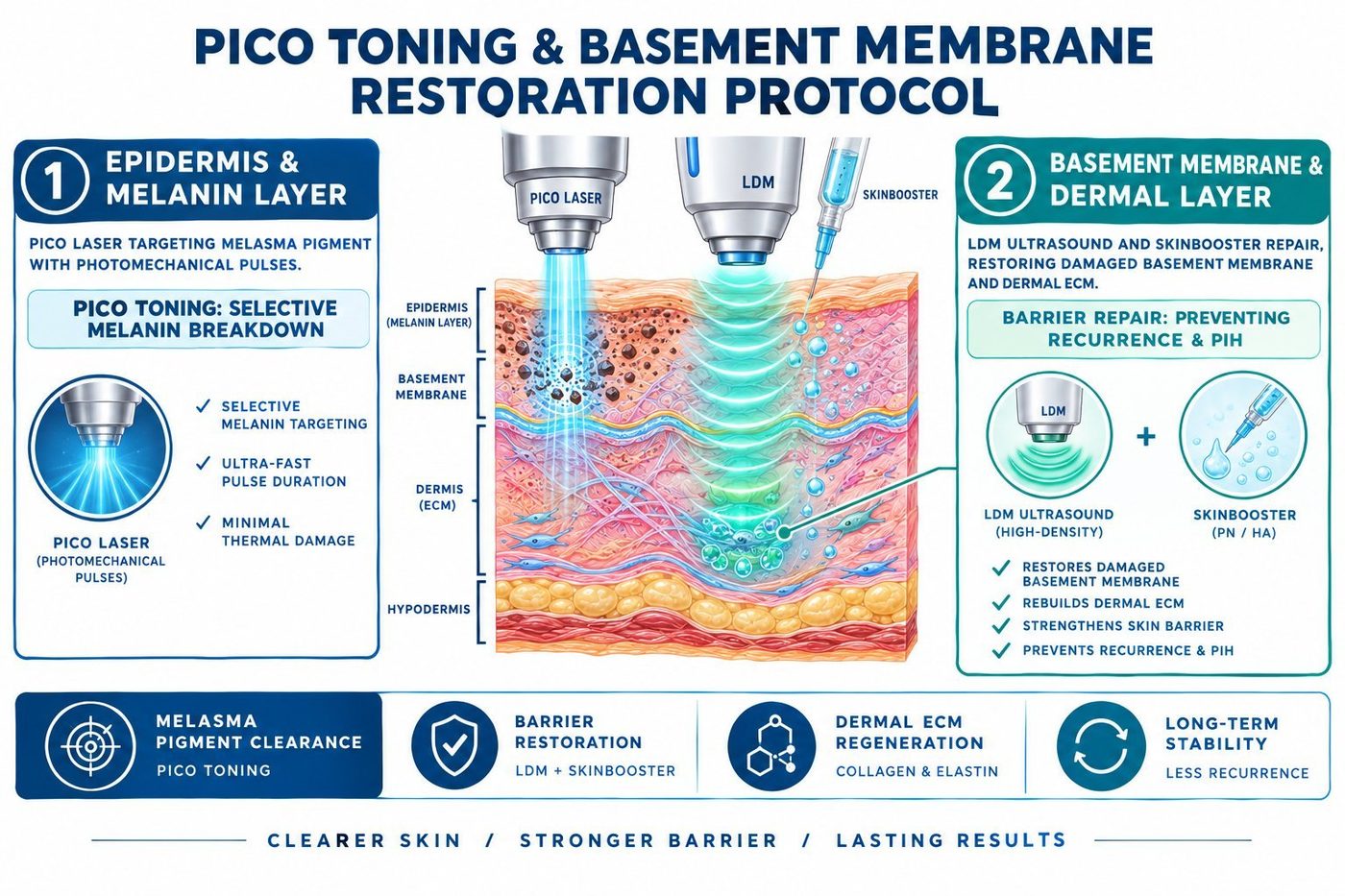
Basement Membrane Damage and Pigment Incontinence: When irritation weakens the basement membrane dividing the epidermis and dermis, epidermal pigment drops down into the dermal layer, worsening into deeper, more stubborn intractable melasma.
Candidate Assessment (Who Benefits Most?)
May Be Suitable For
- Individuals with complex presentations of ill-defined, mottled melasma, blemishes, and ABNOM (Acquired Bilateral Nevus of Ota-like Macules).
- Those who experienced side effects from previous toning treatments such as thinned, reddened skin or darkened pigmentation.
- Anyone seeking to improve pores, fine lines, and skin texture simultaneously alongside pigment treatment.
Technological Distinctions of Pico Toning in Treating Pigmentation
- Precise Shattering Centered on the Photomechanical Effect: Unlike conventional lasers focused on photothermal effects, instantaneous shockwaves in picosecond units shatter melanin like fine dust. The smaller the shattered pigment particles, the faster they are excreted through lymphatic circulation.
- Minimizing Thermal Damage to Surrounding Normal Tissue: Because thermal transfer time is extremely short, damage to surrounding epidermal and dermal cells as well as skin irritation is minimized, helping lower the risk of rebound hyperpigmentation.
- Dermal Regeneration Using MLA/DOE Lenses (Pico MLA): Equipping specialized lenses induces optical micro-damages (LIOB) in the dermis, promoting autologous collagen and elastin regeneration without epidermal damage.
Comparison: Nano-second (Conventional) Toning vs. Pico-second Toning
| Category | Conventional Nano-second Toning | Ruby Pico Toning |
|---|---|---|
| Energy Delivery Speed | 1 billionth of a second (Nano-second) | 1 trillionth of a second (Pico-second) |
| Main Destruction Mechanism | Photothermal-centered destruction | Photomechanical-centered precise shattering |
| Pigment Particle Size | Shattered into gravel/sand sizes | Precisely shattered into ultra-fine dust/powder sizes |
| Surrounding Thermal Damage | Potential irritation and redness from heat accumulation | Minimized thermal damage and irritation with rapid recovery |
| Side Effect Risk | Risk of rebound PIH and hypopigmentation | Lower risk of rebound side effects |
Recommended Treatment Intervals and Recovery Period
- Treatment Interval: For melasma and intractable pigmentation, steady sessions every 1 to 2 weeks for 10 sessions or more are recommended.
- Downtime: Mild redness post-treatment naturally subsides within 1 to 2 hours, causing minimal disruption to daily life.
Combination Care Protocols for Intractable Pigmentation
- Pico Toning + LDM Water Drop Lifting: Following pico laser irradiation, LDM ultrasound strengthens the skin barrier and creates a moist dermal environment to accelerate pigment excretion and alleviate irritation.
- Pico Toning + Skinboosters (Rejuran / Exosome): Helps rebuild damaged basement membranes and dermal environments to suppress overactivation of melanocytes.
Clinical Insights & Practitioner Notes (Doctor LEE Dongmin)
Treating melasma should not be an "attack" that forcibly strips away pigment, but rather a "soothing" process that calms overactivated pigment cells and harmoniously nurtures the dermal environment.
Prior to treatment, I precisely analyze epidermal melasma, dermal pigmentation, and hidden vascular distribution using precision skin diagnostic devices like Janus. Depending on the depth and pattern of the pigmentation, I apply a 'Custom Pico Dual-Tuning Technique' that adjusts wavelengths and energy densities across multiple stages, aiming to lower the chance of recurrence by strengthening the skin barrier alongside pigment destruction.
Precautions Before & After Treatment
- Thorough Sun Protection: To prevent pigment recurrence, make sure to apply sunscreen (SPF 50+/PA+++) 30 minutes before going out and reapply every 2 to 3 hours.
- Avoid Skin Friction: Minimize skin irritation during cleansing by avoiding vigorous rubbing, deep cleansing, or scrub products.
- Ample Moisturizing Care: Generously apply moisturizing and regenerative creams to ensure smooth skin regeneration and pigment excretion post-treatment.
This article provides general medical information and does not replace individual diagnosis or treatment. Effects, recovery time and side effects can differ with skin condition and constitution, so please decide on any procedure after consulting a doctor directly.