
Pores & Scars
Depressed Scars and Enlarged Pores: Pico Fractional vs. Potenza
Compare how pico fractional and Potenza work for depressed scars and enlarged pores, their pros and cons, and how to choose by skin condition.

Dr. Jung HUH MD · RUBY DERMATOLOGY
· 5 min read
Hello, I am Doctor HUH Jung, representative director of Ruby Dermatology Clinic, dedicated to helping you restore your skin's natural vitality and smoothness.
My pores keep getting larger and I'm bothered by depressed acne scars from my youth, but should I get Pico Fractional or Potenza?
The question chosen for our final 20th Doctor's Note is one of the hottest topics in the consultation room: a comparative analysis of comprehensive pore and scar solutions. Both Pico Fractional and Potenza are high devices for treating pores and depressed scars, but their mechanisms for delivering energy to the skin (light vs. needle radiofrequency) are entirely different. To enhance treatment satisfaction, the right choice must be made based on your specific scar morphology, pore depth, and desired recovery period (downtime).
3-Line Key Takeaways
- Difference in Mechanism: Pico Fractional creates micro-cavities in the dermis without epidermal damage using ultra-short laser shockwaves (LIOB) to regenerate collagen, whereas Potenza utilizes microneedles that directly penetrate and deliver radiofrequency (RF) thermal energy.
- Recommendations by Scar/Pore Type: Pico Fractional is useful for scars with relatively clear boundaries and texture improvement, while Potenza is effective for deep butterfly-zone pores with abundant oil/sebum and skin accompanied by flushing.
- Synergistic Combination: Alternating or combining Pico Fractional and the Potenza CP-25 Pumping Tip—which boasts high drug delivery efficiency—across skin layers multiplies the recovery rate of depressed scars.
Pico Fractional vs. Potenza: Fundamental Differences in Operating Principles
Both treatments share the principle of creating micro-injuries (coagulation zones) in the dermal layer to trigger self-healing responses and regenerate collagen, but their approaches differ completely.
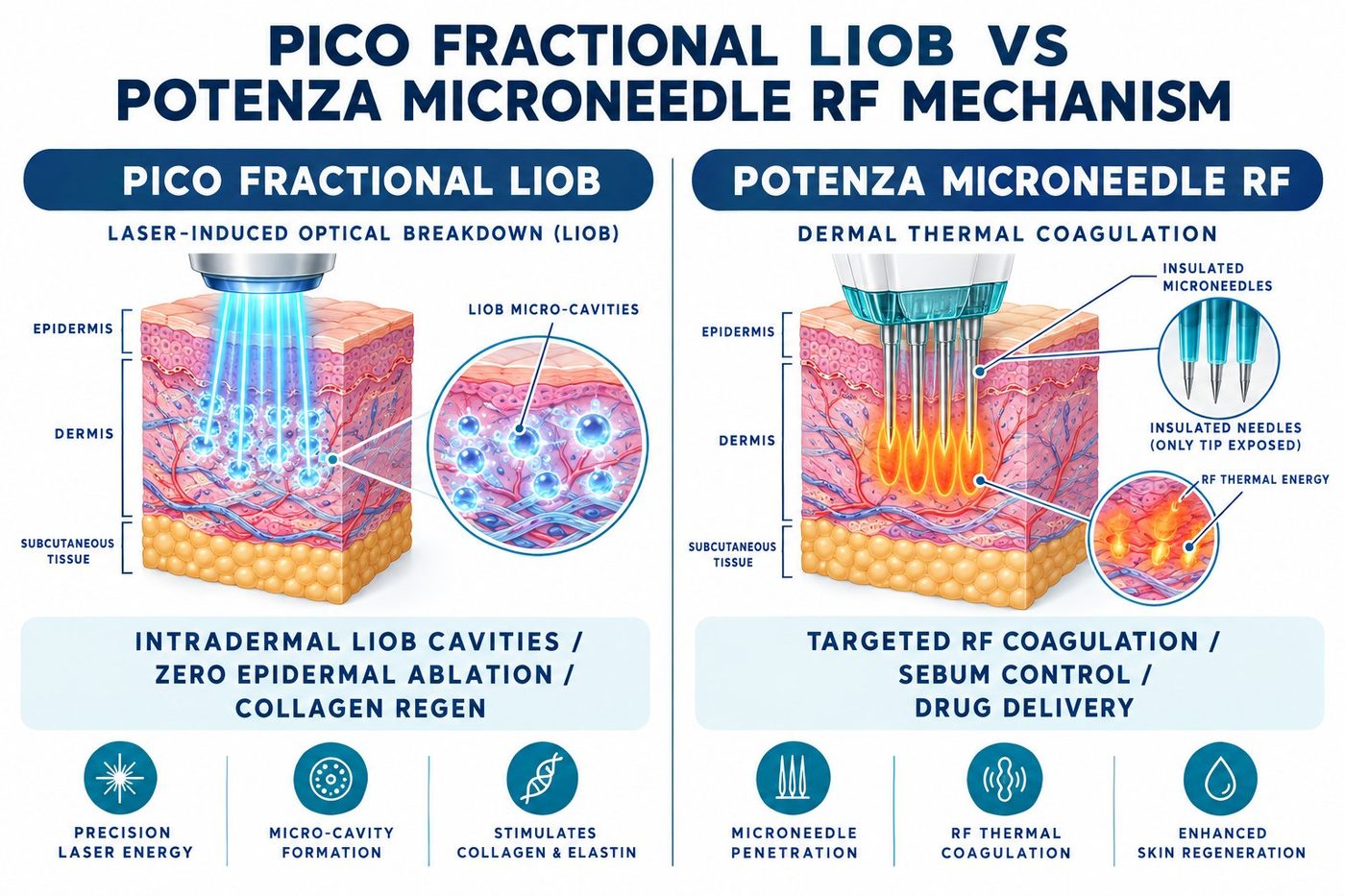
Pico Fractional Laser (LIOB Mechanism)
Principle: Splits picosecond (one trillionth of a second) laser beams via a Micro Lens Array (MLA) tip to induce LIOB (Laser-Induced Optical Breakdown) phenomena within the dermis without surface damage.
Features: Creates microscopic cavities (bubbles) deep inside the dermis without epidermal ablation, triggering powerful collagen remodeling without surface wounds or scabs.
Potenza Microneedle RF
Principle: Sterilized microneedles directly penetrate the epidermis and subsequently emit radiofrequency (RF) thermal energy from their tips.
Features: Simultaneously induces sebaceous gland contraction and collagen denaturation in the dermis, while utilizing negative-pressure pumping tips to deliver skinboosters like Juvelook deep into the dermal layer without loss.
Personalized Selection Criteria by Skin Concern
When Pico Fractional Is Recommended
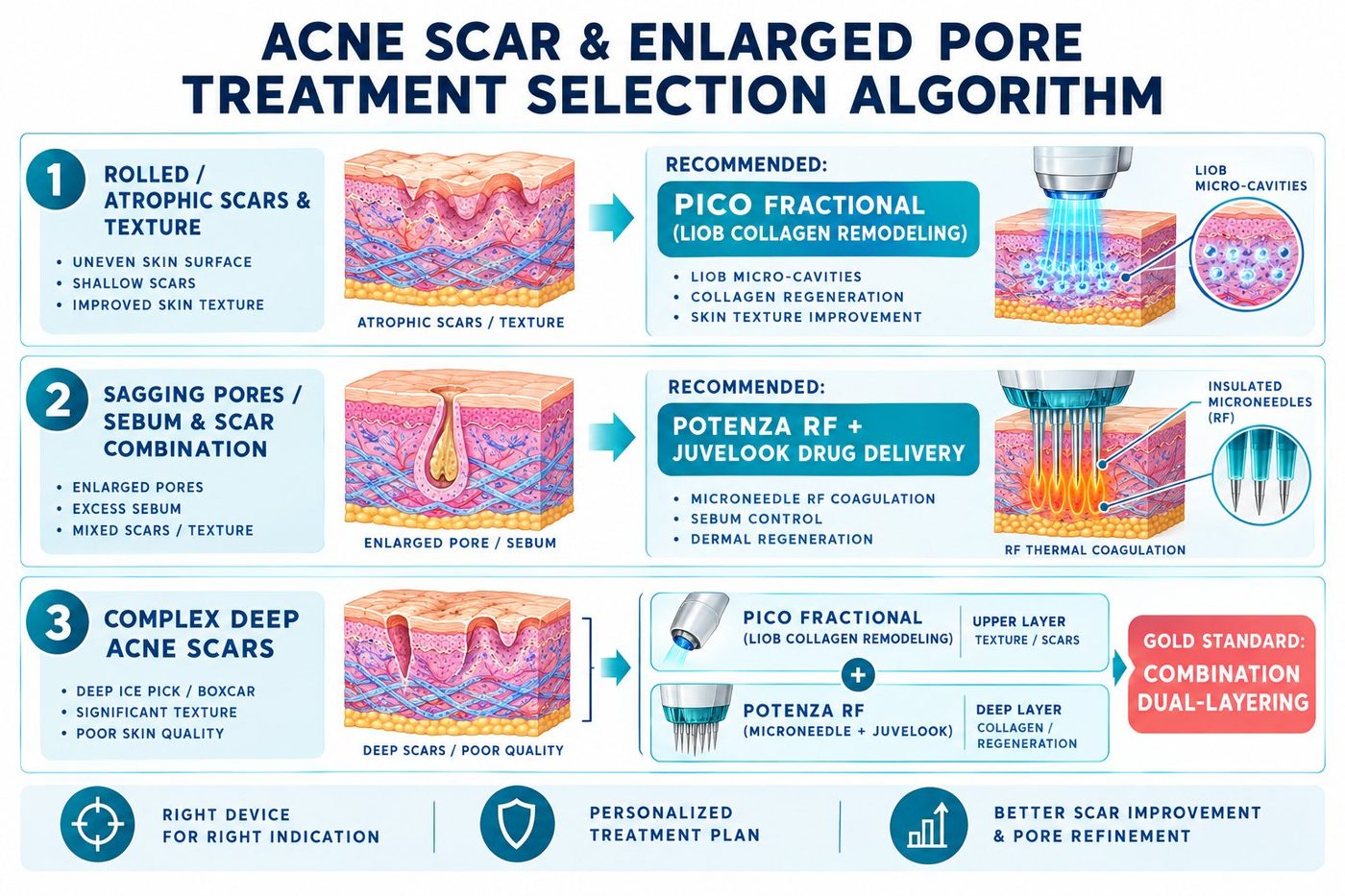
- If you want to smoothly refine the borders of depressed acne scars (icepick, rolling types).
- If you want to simultaneously smooth out surface micro-unevenness and rough skin texture.
- If you found traditional fractional laser treatments with long-lasting redness or scabbing burdensome.
When Potenza Is Recommended
- If you struggle with enlarged pores centered around the butterfly zone alongside excessive sebum secretion.
- If you wish to volumize depressed areas by infusing collagen skinbooster medications like Juvelook Skin into the dermal layer.
- If you want to comprehensively care for facial flushing or decreased elasticity alongside pores and scars.
Comparative Analysis: Pico Fractional vs. Potenza
| Category | Pico Fractional | Potenza RF |
|---|---|---|
| Energy Principle | Picosecond Laser Shockwave (LIOB) | Microneedle + Radiofrequency (RF) |
| Core Target Layer | Upper and mid-dermis (LIOB micro-spaces) | Mid and lower dermis (RF thermal coagulation points) |
| Primary Indications | Depressed acne scars, surface unevenness, texture improvement | Enlarged pores, sebum control, skinbooster penetration |
| Downtime | 1–3 days of mild redness (minimal scabbing) | 1–2 days of mild redness and micro-needle marks |
| Drug Delivery | Post-treatment topical application and absorption | Direct penetration via vacuum pumping tip (CP-25) |
Differences in Recovery Period (Downtime) and Pain
Pain
Pico Fractional: Accompanied by a stinging photoacoustic sensation when performed after topical numbing cream, making it relatively manageable.
Potenza: Heavy pressure from needle penetration and RF heat is felt, but comfortable treatment is possible with sufficient numbing.
Downtime
Pico Fractional: Mild redness and pin-point micro-bleeding may occur immediately after treatment, but they subside within 1 to 3 days without forming hard scabs, allowing swift return to daily life.
Potenza: Mild redness and embossing appear on the treatment day, while face washing and light makeup become possible the next day.
Recommended Treatment Intervals and Treatment Plans
- Pico Fractional: 3 to 5+ sessions spaced 3 to 4 weeks apart allow dermal collagen to fill in, softening the borders of depressed scars.
- Potenza: 3 to 5 sessions spaced 3 to 4 weeks apart; pore-tightening effects accumulate continuously when combined with Juvelook.
Combination Approaches for Pores and Depressed Scars
- Potenza (CP-25) + Juvelook Skin: Negative pressure created by Potenza's pumping tip drives Juvelook medication directly into the dermis, explosively inducing autologous collagen generation right from the base of depressed scars.
- Pico Fractional + Potenza Dual Layering Care: A combination solution addressing deep, wide pores and sebaceous glands in the lower dermis with Potenza, while treating surface depressed scars and texture with Pico Fractional's LIOB mechanism.
Clinical Insights & Practitioner Notes (Doctor HUH Jung)
As I have emphasized throughout writing these 20 Doctor's Notes, the essence of all skin treatments is "customized design based on accurate diagnosis".
For pores and scars alike, precision diagnostic systems must clearly differentiate scar morphology (icepick, boxcar, rolling types) from pore origins (excess sebum type vs. decreased elasticity type). For acne scars with deep surface unevenness, Pico Fractional's LIOB energy is finely calibrated to sever fibrotic scar bands, whereas cases accompanied by sagging pores and inner dryness are managed by precisely injecting Juvelook into the dermis via Potenza's CP-25 tip. Harmonizing these two mechanisms creates a smooth skin foundation that plumps from within without skin-irritation burdens.
Precautions Before & After Treatment
- Ample Moisture and Regenerative Care: Because active dermal collagen remodeling occurs post-treatment, apply regeneration creams and hydrating moisturizers thoroughly and frequently.
- Sun Protection: Ultraviolet rays hinder the formation of regenerating dermal collagen; apply SPF 50+ / PA+++ sunscreen daily.
- Avoid Irritation: Refrain from saunas, jjimjilbangs, intense exercise, alcohol-containing toners, or physical scrubs for one week post-procedure.
This article provides general medical information and does not replace individual diagnosis or treatment. Effects, recovery time and side effects can differ with skin condition and constitution, so please decide on any procedure after consulting a doctor directly.