
Lifting & Elasticity
Thread Lifting: Preventing Awkward Expressions and Dimpling
Why unnatural expressions or dimples can appear after thread lifting, how thread selection and insertion depth help prevent them, and what to do afterward.

Dr. Dong Min LEE MD · RUBY DERMATOLOGY
· 5 min read
Hello, I am Doctor LEE Dongmin of Ruby Dermatology Clinic, creating the natural beauty inherent in skin through delicate design and careful medical care.
I want to get a thread lift, but I hesitate because I'm afraid my cheekbones might look bigger or my skin might dimple, making my expressions look awkward.
This is one of the most common reasons patients hesitate when consulting for thread lifting to tidy up sagging facial lines.
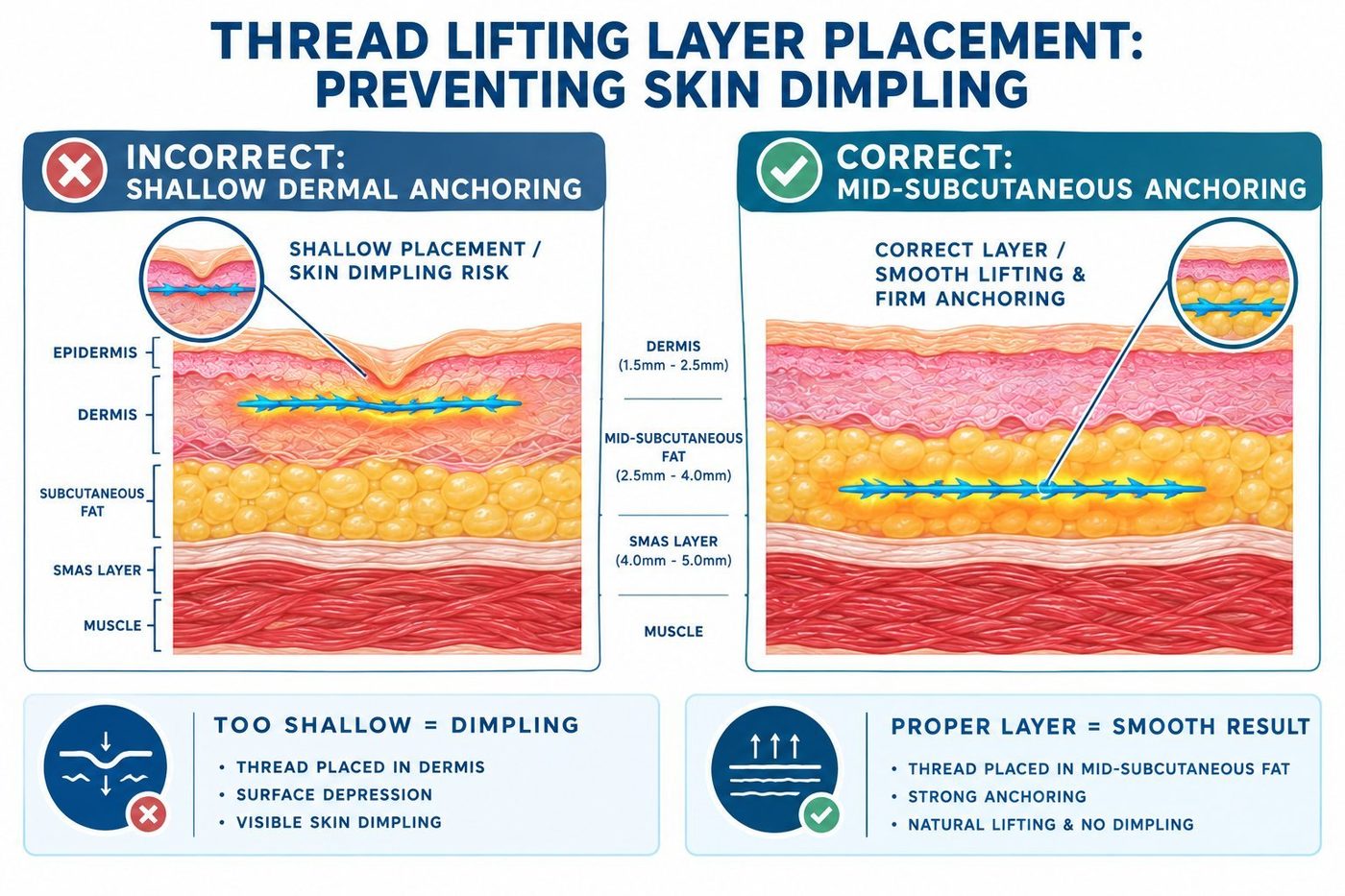
Unnaturalness or skin depression (dimpling) after thread lifting occurs when threads are anchored in the wrong anatomical layer unsuited to the skin's thickness or when the design plan is inadequate. By accurately understanding the anatomical structure of the skin and precisely inserting threads into the correct layer, you can complete a firm, natural V-line without any awkwardness.
3-Line Key Takeaways
- Causes of Dimpling: Dimpling occurs when barbed threads (Cog) with fixing power catch too close to the skin surface in the lower dermis or shallow fat layer, pulling the surface and causing temporary or continuous depression.
- Preventing Awkward Expressions: It is important to account for individual movement trajectories of the muscles of facial expression and apply a multi-layer custom design tailored to skin thickness and sagging rather than excessive traction.
- Complex Matching Solutions: Layering Jamber threads or skinboosters—which assist with flexible volume and texture improvement alongside fixation cogs—results in a smooth, natural contour.
Anatomical Reasons for Dimpling and Unnaturalness After Thread Lifting
Thread lifting is not a simple "pulling up" procedure, but rather a delicate technique that requires a proper understanding of anatomical layers to correctly settle the threads.
Dimpling Caused by Shallow Layer Fixation: If barbs (cogs) catch in a dermal layer that is too shallow, the skin surface is pulled inward unevenly, causing a dimpled depression. Conversely, if placed too deep below the fat layer, it loses anchoring strength and slides downward.
Facial Muscle Stimulation & Cheekbone Widening: Exerting excessive upward force in a vertical direction around the cheekbone area hinders muscle movement during smiling, resulting in awkward expressions or crowding lateral fat to make cheekbones look wider.
Candidate Assessment (Who Benefits Most?)
May Be Suitable For
- Individuals wishing to immediately lift jowls, nasolabial folds, and collapsed jawlines to create natural contours.
- Those who feel laser devices alone have limitations in lifting and pulling sagging tissue.
Requires Precise Procedural Design For
Individuals with very thin skin where thread outlines are easily visible (requires complementary layering centered on flexible, soft volume/Jamber threads).
3 Technical Points for Natural Thread Lifting
- Accurate Target Layer Settlement (Mid-to-Lower Subcutaneous Fat Layer): To avoid epidermal damage and securely anchor barbs, the upper SMAS subcutaneous fat layer must be precisely targeted.
- Vector Custom Design: Rather than pulling purely vertically, a 3D curved vector tailored to individual expression movements and cheekbone skeletal structures is designed to secure naturalness when speaking or smiling.
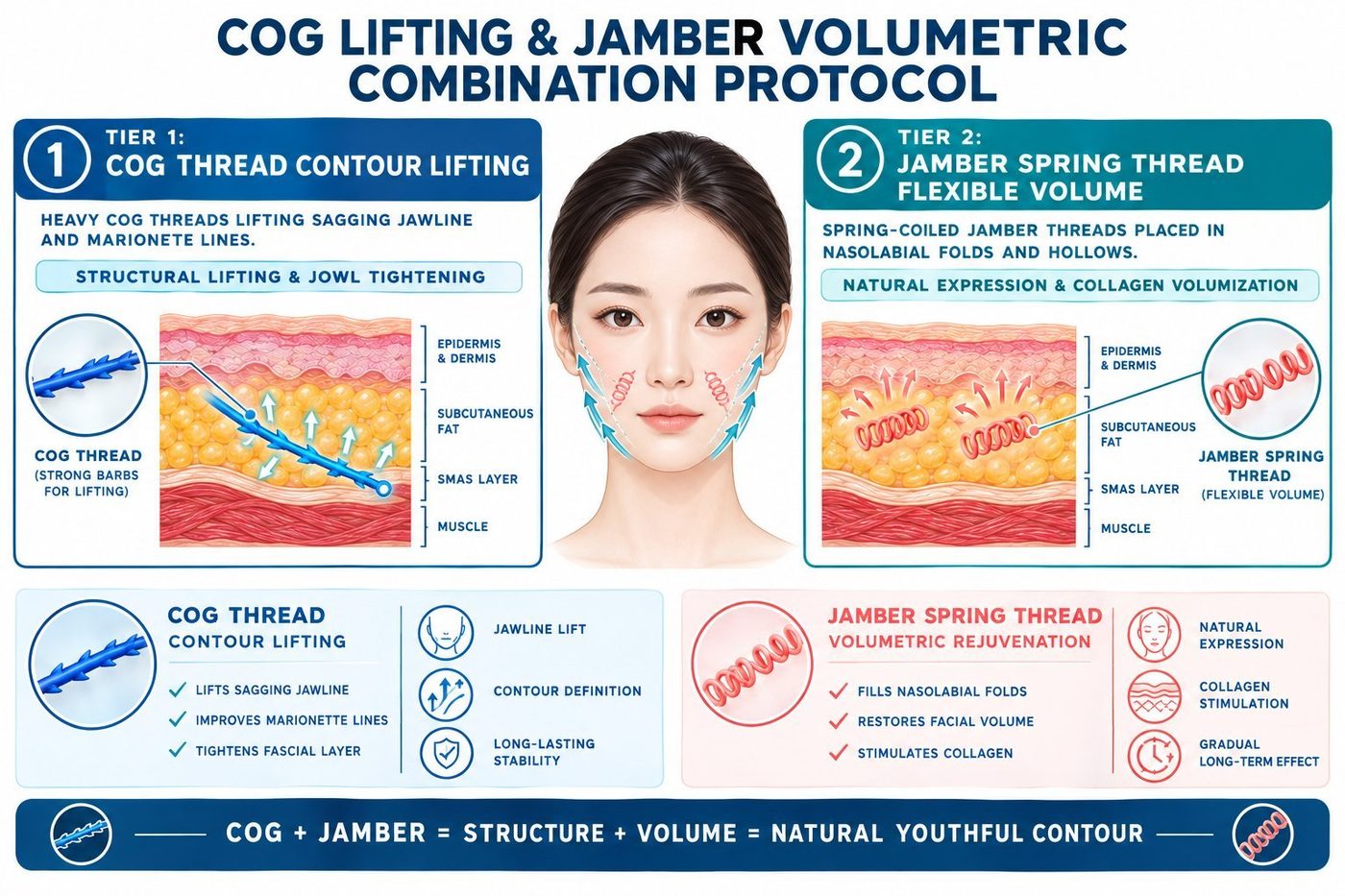
- Volume & Elasticity Reinforcement Using Jamber Threads: Spring-shaped Jamber threads are flexibly applied to high-motion areas like nasolabial folds or hollow depressions, reducing the rigidity of cog threads while inducing autologous collagen generation to fill natural volume.
Comparison of Thread Lifting Types
| Category | Strong Traction Cog Threads | Volume & Elasticity Reinforcement Jamber Threads |
|---|---|---|
| Thread Shape | Strong barb structure (Cog) | Net structure wound into a spring coil |
| Core Role | Lifts sagging jowls, jawlines, and double chins | Fills nasolabial folds and hollows while tightening texture |
| Naturalness | Requires initial adaptation period due to strong fixation | Highly flexible movement makes expressions very natural |
| Synergy Combination | Forms the main structural framework for contour lifting | Buffers dimple-prone areas and provides autologous collagen remodeling |
Recovery Period and Duration
- Recovery Period (Downtime): Mild bruising or swelling may occur for 2 to 3 days post-procedure, but with precise layer insertion, dimpling often settles within about one week (results vary).
- Duration: Varies depending on PDO, PLLA, and PCL materials, but typically lasts 1 year to 1.5 years, while collagen tissue induced as threads dissolve maintains ongoing elasticity.
Combination Approaches to Reduce Awkward Expressions
- Mint/Cog Thread + Jamber Thread Complex Lifting: After pulling and anchoring sagging contours with cog threads, Jamber threads are layered onto high-motion areas like nasolabial folds and cheek depressions to complete a smooth, three-dimensional volume.
- Thread Lifting + LDM Hydration Soothing Care: Supplying dermal moisture and soothing tissue via LDM ultrasound immediately post-procedure minimizes swelling and irritation while assisting smooth settling.
Clinical Insights & Practitioner Notes (Doctor LEE Dongmin)
The success of thread lifting does not depend on "how strongly you pull," but on "how naturally harmony is achieved."
Before treatment, I closely observe the patient's skin thickness, fat volume, and movement trajectories of facial expression muscles used during smiling. For areas with thin skin, I cross-place Jamber threads that flexibly reduce friction instead of strong cog threads, applying a '3D Multi-layer Anchor Technique' that disperses pulling angles across multiple vectors. This provides an impeccably firm facial line without awkwardness or dimpling side effects immediately after the procedure.
Precautions Before & After Treatment
- Avoid Excessive Facial Expressions: For 1 to 2 weeks post-treatment, refrain from opening your mouth too wide, chewing hard foods, or rubbing your face vigorously.
- Proper Sleeping Posture: Sleeping upright rather than facing down or sideways for one week post-procedure helps ensure proper thread settlement.
- Avoid Heat Stimulation: To support dermal regeneration and tissue settling, avoid saunas, jjimjilbangs, alcohol consumption, and intense workouts for one week.
This article provides general medical information and does not replace individual diagnosis or treatment. Effects, recovery time and side effects can differ with skin condition and constitution, so please decide on any procedure after consulting a doctor directly.