
Contouring
JuveLook Volume vs. Fat Grafting for Sunken Cheeks and Marionette Lines
Compare JuveLook Volume and autologous fat grafting for hollow cheeks and marionette lines: how each works, risks, recovery and how to choose.

Dr. Jung HUH MD · RUBY DERMATOLOGY
· 4 min read
Hello, I am Doctor HUH Jung, representative director of Ruby Dermatology Clinic, dedicated to restoring natural contours tailored to skin health and anatomical structure.
As I age, my side cheeks sink and my marionette lines deepen, making my expression look depressed. I'm worried about the survival rate and foreign body sensation with autologous fat grafting, and regular fillers might make my face look lumpy—what is the right choice?
This is a frequent question from patients consulting us about volume loss and contour changes.
The era of blindly filling sunken areas with physical substances has passed. By understanding the difference between Juvelook Volume—which prompts your own skin to generate collagen for natural volume—and fat grafting using autologous tissue, you can work toward a youthful, firm facial line while avoiding awkwardness.
3-Line Key Takeaways
- Autologous Fat Grafting: Involves injecting autologous fat harvested from areas like the thighs or abdomen; while it provides definite initial volume, it carries variables regarding graft survival rates, lumping, and sagging risks.
- Juvelook Volume (PDLLA + HA): A polymer PLA particle that induces autologous collagen generation, creating natural volume that builds up from your own skin rather than artificial volume, along with texture improvement.
- Custom Selection Criteria: Fat grafting is suited for large-scale, immediate contour reconstruction, whereas Juvelook Volume is suitable for gradual, smooth, and natural fullness without foreign body sensations in sunken cheeks, marionette lines, and nasolabial folds.
Why Juvelook Volume? Anatomical Principles of Collagen-Regenerating Skinboosters
Volume loss occurs due to a combination of reduced dermal collagen, weakened subcutaneous fat layers, and fascial (SMAS) laxity, alongside simple fat reduction.
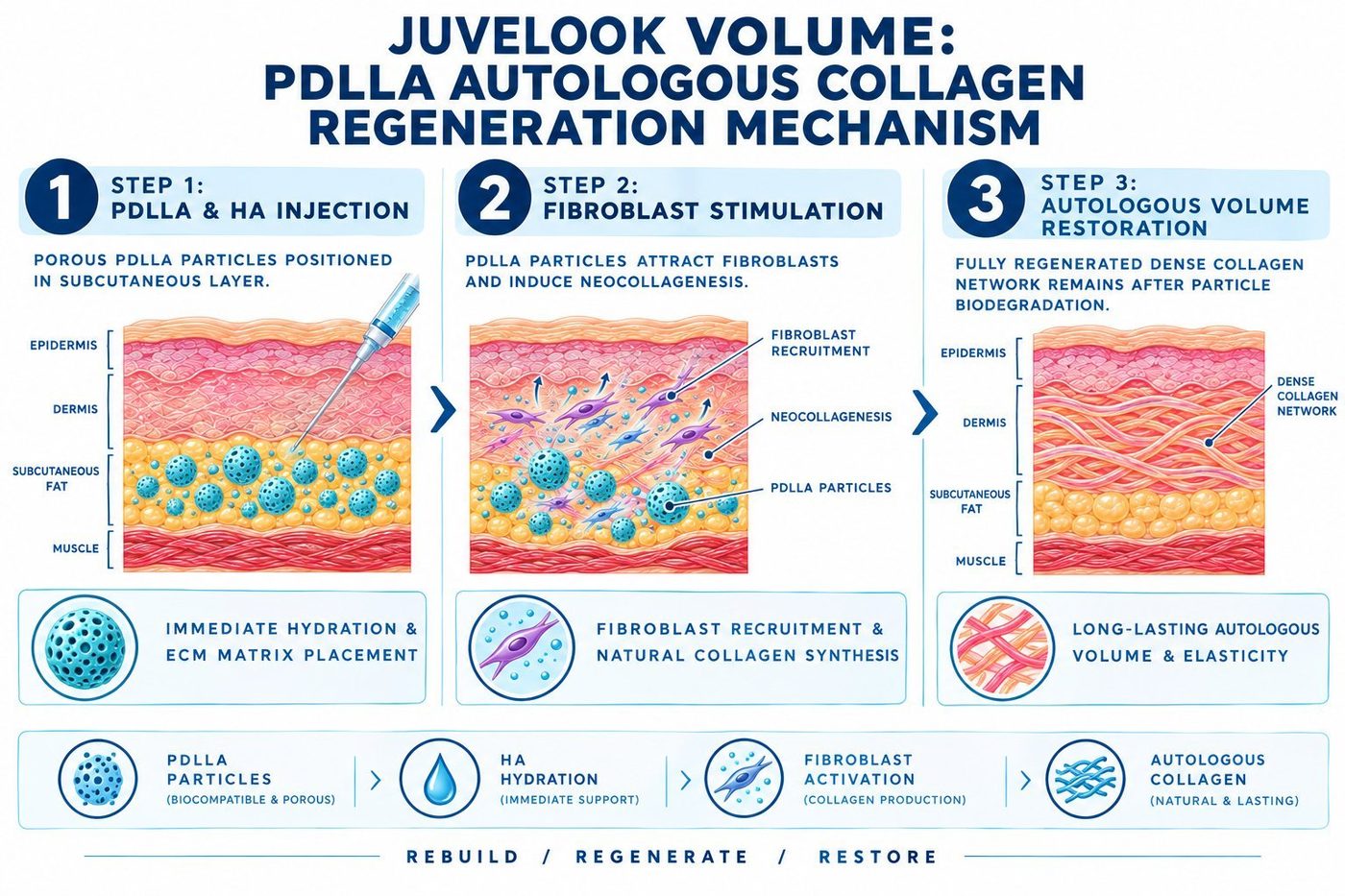
Autologous Collagen-Inducing Mechanism of PDLLA (Poly-D,L-Lactic Acid)
Juvelook Volume settles PDLLA particles with a porous mesh structure into the subcutaneous fat layer and lower dermis, stimulating fibroblasts. Over several months as the particles gradually break down, newly generated collagen cells firmly fill the empty spaces.
Non-Artificial Volume Formation
Unlike regular fillers that remain in a lump at specific sites and can shift or lump together, Juvelook regenerates your own autologous tissue, making facial expressions appear exceptionally natural and soft.
Core Comparison: Juvelook Volume vs. Autologous Fat Grafting
| Category | Juvelook Volume | Autologous Fat Grafting |
|---|---|---|
| Main Ingredients / Materials | PDLLA (Autologous collagen-inducing polymer) + HA | Autologous subcutaneous fat (harvested from abdomen, thighs, etc.) |
| Volume Formation Method | Gradual formation via autologous collagen generation | Direct formation via engraftment of injected fat cells |
| Naturalness / Foreign Body Feel | Minimal foreign body feel, natural-looking during facial expressions | Unnatural feel if initially overcorrected, plus variations in engraftment rates |
| Downtime / Recovery | Minimal bruising and swelling; daily life possible immediately | Recovery of fat harvest site and 1–2+ weeks of swelling |
| Side Effect Risks | Minimized risk of nodules (when hydration protocols are applied) | Risks of fat necrosis, calcification, and downward sagging over time |
Treatment Selection Guide Based on Individual Needs
When Juvelook Volume Is Recommended
- Individuals with hollow side cheeks, temples, nasolabial folds, or marionette lines who need natural filling.
- Those who have an aversion to foreign substances or fillers and wish to smooth and densely fill skin texture with autologous collagen.
- Anyone who finds fat harvest surgery or extended downtime burdensome.
When Autologous Fat Grafting May Be Considered
- Cases requiring immediate, large-scale reconstruction of contour volume across the entire face.
- Individuals with no aversion to fat harvesting who can tolerate swelling during the engraftment process.
Recovery Period and Expected Duration
- Treatment Protocol: Juvelook Volume is recommended as a standard protocol of 3 sessions spaced 1 month apart.
- Duration: The generated autologous collagen volume lasts long-term for 1.5 to 2 years, after which the particles fully degrade into water and carbon dioxide and exit the body.
Achieving Volume & Elasticity: 'Ruby Dual Volume Layering' Synergy
Juvelook Volume + Ulthera / Thermage
Pulling and tightening collapsed contour frameworks and skin barriers with Ulthera or Thermage, followed by filling hollow areas with Juvelook Volume, creates comprehensive anti-aging synergy achieving 'lifting + volume' simultaneously.
Juvelook Volume + Skin Botox
Fulfilling deep volume with Juvelook while managing surface fine lines and pores with Skin Botox completes a structured, dense skin foundation.
Clinical Insights & Practitioner Notes (Doctor HUH Jung)
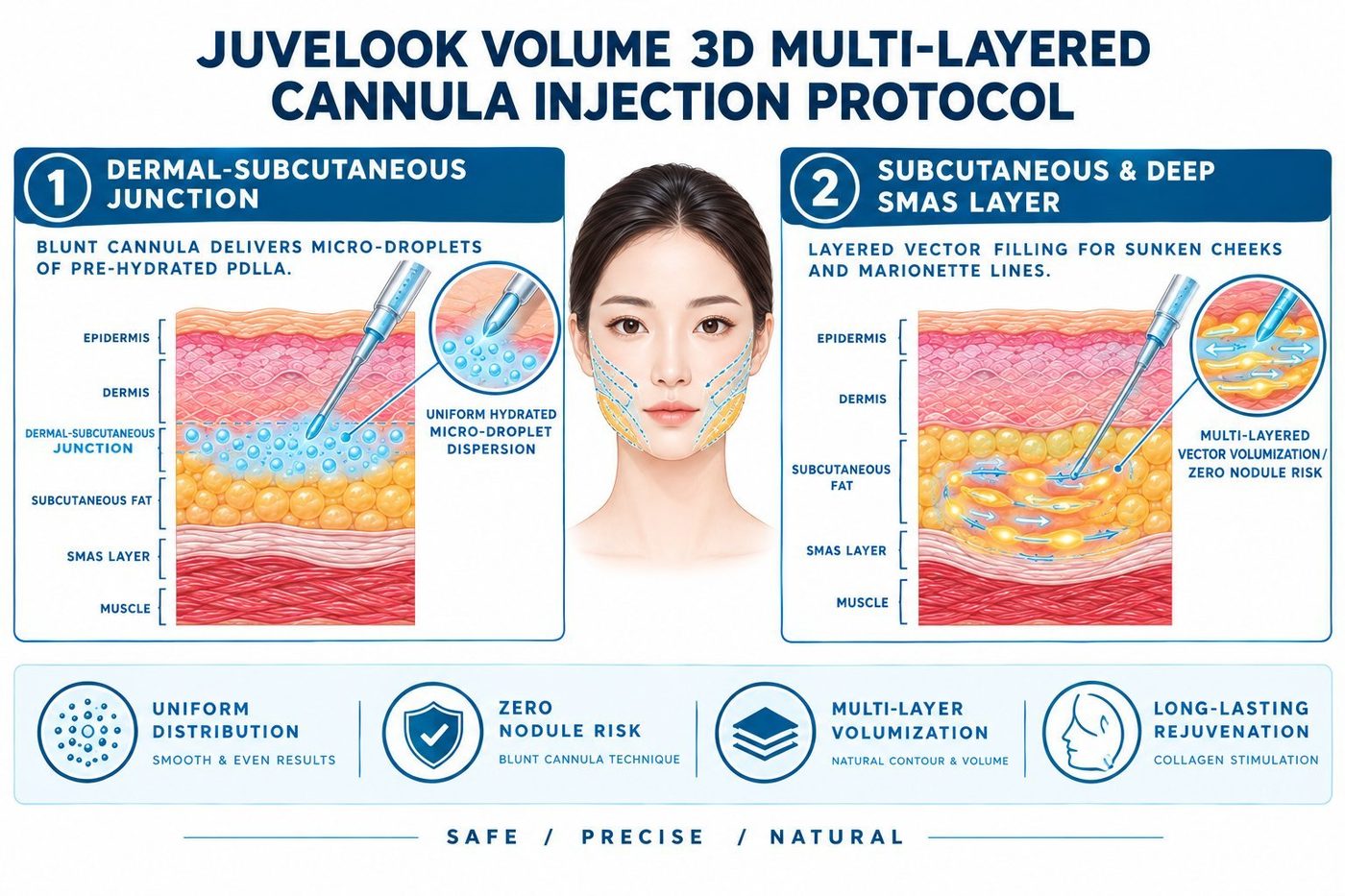
The most crucial elements in Juvelook Volume procedures are a 'precise nodule-preventing hydration protocol' and 'multi-layered cannula injection techniques that respect anatomical planes'.
Days before the procedure, we mix purified water and HA in appropriate proportions through a hydration process so that PDLLA particles form a uniform three-dimensional mesh structure. During the procedure, high-quality blunt-tipped cannulas are used instead of sharp needles to prevent vascular damage, applying a '3D Dual-Layer Vector Injection Method' that densely packs layers into the subcutaneous fat layer and upper fascia. This helps reduce nodule side effects while restoring natural dimension.
Precautions Before & After Treatment
- Treatment Site Massage: For a specified period guided by your medical team, gentle rubbing care is recommended to help particles evenly disperse and build autologous collagen properly.
- Avoid Alcohol and Saunas: Avoid alcohol, smoking, and jjimjilbangs for one week to minimize irritation at the injection site and support collagen production.
- Ample Hydration: Consume at least 1.5L of water daily to facilitate collagen hydration reactions and smooth skin regeneration.
This article provides general medical information and does not replace individual diagnosis or treatment. Effects, recovery time and side effects can differ with skin condition and constitution, so please decide on any procedure after consulting a doctor directly.