
Contouring
Nasolabial Fold Filler: Principles for Reducing Migration and Lumping
Why filler can migrate or lump in the nasolabial area, and how layered injection that considers facial muscles and cannula use help reduce those risks.

Dr. Dong Min LEE MD · RUBY DERMATOLOGY
· 5 min read
Hello, I am Doctor LEE Dongmin of Ruby Dermatology Clinic, completing natural facial contours without awkwardness through delicate anatomical design.
I want to get fillers because my nasolabial folds have deepened, but I'm worried that over time, the filler will shift upward, making my expression look unnatural or the alar-base area look bulky.
This is one of the most common side effects patients worry about when visiting the consultation room regarding wrinkles and volume loss in the nasolabial region.
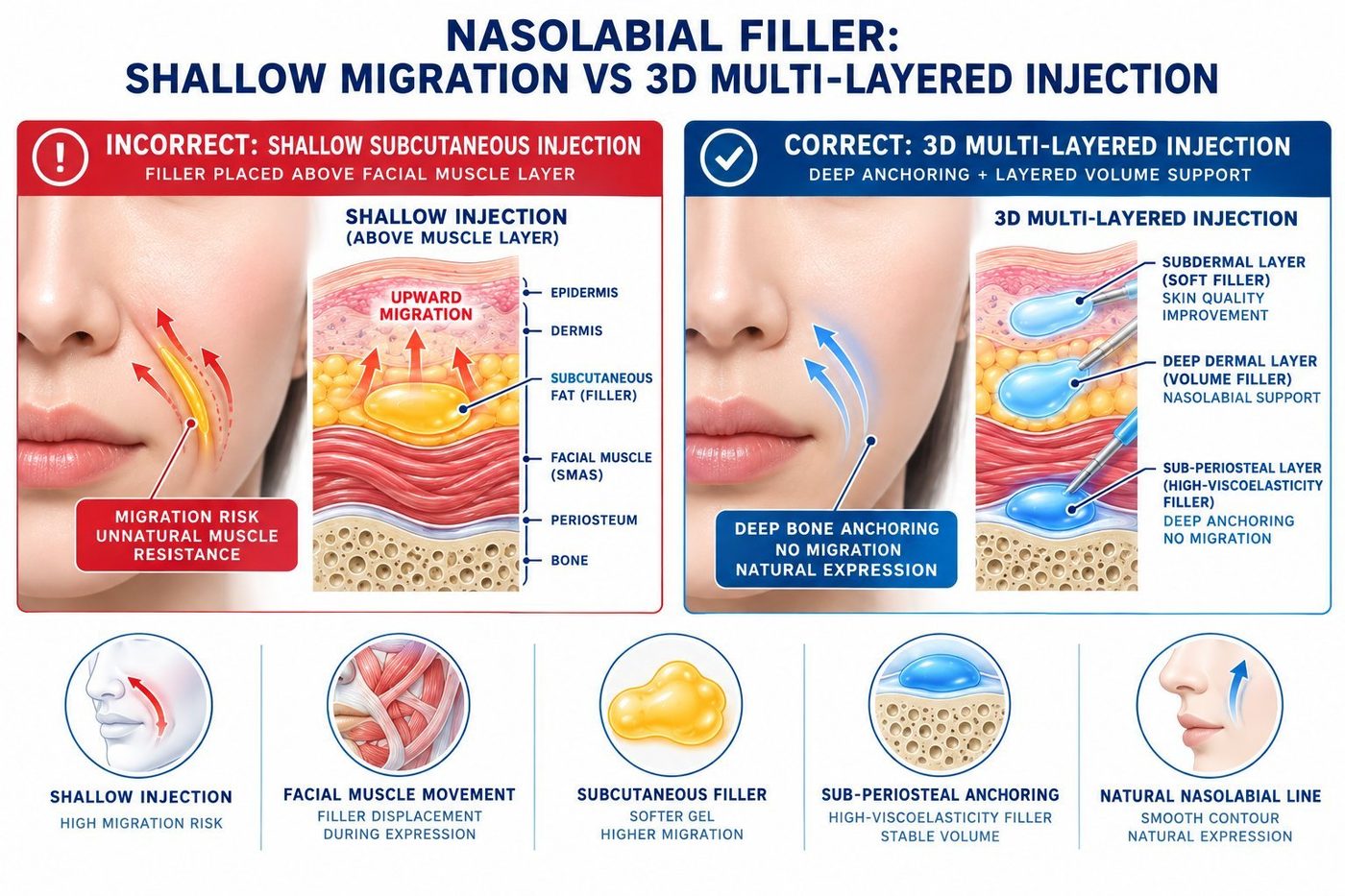
The phenomenon where fillers migrate upward or lump together after nasolabial filler treatment occurs because a simple one-dimensional filling method was applied while ignoring the movement dynamics of facial expression muscles when chewing and smiling. By identifying the precise anatomical positions of facial expression muscles and distributing formulations with appropriate rheological properties into the deep and shallow layers, a 3D multi-layered injection technique can achieve a smooth nasolabial line that remains natural even during movement.
3-Line Key Takeaways
- Causes of Nasolabial Filler Migration: The nasolabial area features highly active facial expression muscles such as the levator labii superioris. Injecting filler all at once into the shallow layer directly above these muscles causes it to be pushed upward by muscular pressure.
- 3D Multi-Layered Principle: A high-cohesivity, high-elasticity filler builds structural support in the deep sub-periosteal layer, while flexible, moderate-viscosity filler or skinboosters smooth out wrinkles in the shallow subdermal layer.
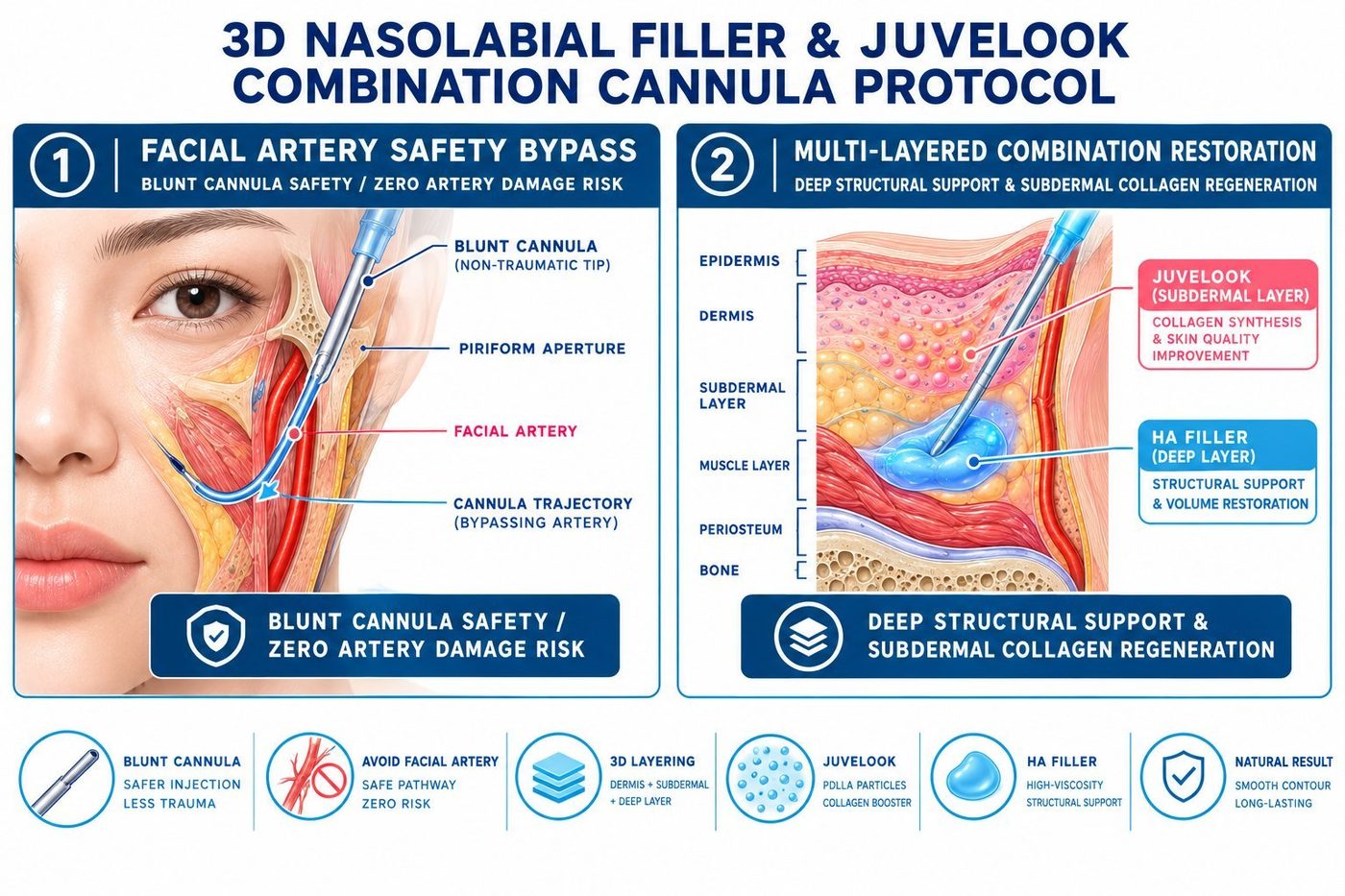
- Cannula Procedure: Because the facial artery passes through the lower face danger zone, blunt, high-quality cannulas should be used instead of sharp needles to prevent vascular injury.
Anatomical Reasons Why Nasolabial Fillers Migrate Upward or Lump
Nasolabial folds are not formed merely by skin creases, but by a combination of maxillary (upper jaw bone) resorption, downward-medial shifting of the jowl fat pads, and repetitive contraction of facial expression muscles.
Dynamic Muscle Pressure: Muscles lifting the corners of the mouth contract strongly during smiling or speaking. If filler is placed heavily in the subcutaneous fat layer directly above these muscles, movement subjects it to pressure, forcing it upward toward areas of lower muscular resistance (sub-zygomatic region).
Vascular Distribution and Alar-Base Depression: The starting point of the nasolabial fold (beside the nasal ala) is an anatomical danger zone close to the facial artery. Setting injection depths incorrectly without understanding this structure increases not only filler migration risks but also vascular compression hazards.
Candidate Assessment (Who Benefits Most?)
May Be Suitable For
- Individuals with deep hollows beside the nasal base that make the mouth appear relatively protruding (protruding mouth appearance).
- Those whose nasolabial folds make them look older and fatigued.
- Anyone hesitant about repeat procedures due to past experiences with filler lumping or shifting.
Requires Precise Procedural Design For
Individuals whose cheek fat sags heavily downward, where overlapping lower cheek skin is the primary cause of nasolabial folding (simple filler injection can make the face look broader; thread lifting or contour lasers must be combined).
3 Procedural Principles for Migration-Free, Natural Nasolabial Fillers
- Deep Sub-Periosteal Layer Support Creation: HA fillers with high gel maintenance and elasticity are injected onto the deep bone surface of the maxilla to firmly prop up the sunken alar-base bone structure. Because it is positioned beneath the muscular layer, the filler will not shift during movement.
- Subdermal Layer Micro-Coverage of Fine Lines: Remaining shallow linear wrinkles on the skin surface are smoothly micro-coated with flexible, soft hyaluronic acid formulations or Juvelook to seamlessly connect expressions without foreign body sensations.
- Utilizing Blunt Micro-Cannulas: To reduce the risk of facial artery and vascular injury while minimizing pain and bruising, blunt cannulas are used for careful execution.
Comparison: Conventional Single-Layer Injection vs. 3D Multi-Layered Injection
| Category | Conventional Single-Layer Filler Injection | 3D Multi-Layered Injection Technique |
|---|---|---|
| Target Layer | Subcutaneous fat layer (focused single-layer injection) | Sub-periosteal (deep layer) + Subdermal (shallow layer) dual layers |
| Filler Selection | Single rheological formulation used | High-elasticity firm filler + flexible micro-filler/skinbooster combination |
| Migration Risk | Upward displacement occurs due to facial muscle stimulation | Helps reduce displacement/migration via sub-muscular skeletal anchoring |
| Natural Expressions | Appears bulky or borders look pronounced during smiles | Skin folds flexibly with movement for absolute naturalness |
| Safety (Vascular) | Risk of vascular injury during needle procedures | Secured safety via cannula techniques bypassing vascular distribution layers |
Recovery Period and Expected Duration
- Recovery Period (Downtime): Due to blunt cannula usage, bruising and swelling after treatment are typically minimal, allowing a relatively quick return to daily life and work.
- Duration: Maintained without distortion for 1 year to 1.5 years, depending on product formulation and multi-layered combination methods.
Combination Protocol for Natural-Looking Nasolabial Improvement
- Nasolabial 3D Filler + Juvelook: Deep hollows are supported with fillers, while minor surface wrinkles and lowered skin elasticity around the nasolabial folds are layered with Juvelook to smoothly fill them via autologous collagen.
- Nasolabial 3D Filler + Inmode / Oligio (RF Contour Tidy): Tightly overlapping cheek fat above the nasolabial folds is first smoothed out using radiofrequency lifting devices before filler placement, yielding a much lighter, slimmer contour.
Clinical Insights & Practitioner Notes (Doctor LEE Dongmin)
Nasolabial filler is not an injection technique that simply fills up volume indiscriminately; it is a three-dimensional stereoscopic coordination procedure that understands overall facial shading and muscle movement to remove unnecessary shadows.
Before treatment, I have patients make wide smiling or speaking expressions to precisely assess facial expression muscle movement and depth of depressions. Factoring in facial artery locations, I build a solid pillar with high-elasticity filler in the sub-periosteal layer, then apply a '3D Multi-Layered Dual Injection Technique' that deposits very small quantities while avoiding muscle-stimulated layers. This aims for a smooth, natural-looking impression, with a lower risk of foreign body sensations or lumping right after the procedure.
Precautions Before & After Treatment
- Avoid Excessive Expressions: Refrain from laughing with wide mouth openings or chewing hard foods aggressively for 1 to 2 weeks post-treatment.
- Avoid Stimulating Treatment Sites: While the filler settles, avoid pressing the treated area forcefully with your hands or receiving facial meridian massages.
- Avoid Alcohol and Heat Stimulation: Avoid alcohol, saunas, and jjimjilbang use for one week to prevent initial bruising or swelling and support secure settling.
This article provides general medical information and does not replace individual diagnosis or treatment. Effects, recovery time and side effects can differ with skin condition and constitution, so please decide on any procedure after consulting a doctor directly.