
Contouring
Lip Filler Migration Into the Philtrum: Causes and Prevention
Why lip filler can migrate toward the philtrum, how injection technique and filler choice help prevent it, and what can be done if it has already spread.

Dr. Jung HUH MD · RUBY DERMATOLOGY
· 5 min read
Hello, I am Doctor HUH Jung, representative director of Ruby Dermatology Clinic.
Over time after getting lip fillers, the filler overflowed past my lip border and accumulated thickly in my philtrum.
My upper lip bulges outward, making it look clumsy and unnaturally like a 'Donald Duck' mouth. What should I do?
While lip filler procedures generally offer high satisfaction, an increasing number of patients express distress over 'filler migration'—a phenomenon where filler shifts from its original placement, traveling along the lip border (Vermilion Border) into the philtrum or adjacent tissues over time.
The lips are encircled by the orbicularis oris muscle, which moves thousands of times daily. This subjects the area to dynamic forces, making it exceptionally vulnerable to filler displacement if overfilled or injected into the incorrect anatomical layer. Here is an anatomical breakdown of its causes, prevention, and corrective strategies.
3-Line Key Takeaways
- Causes: Migration occurs due to a combination of excessive filler volume, disruption of the Vermilion Border barrier, incorrect injection layer placement, and continuous mechanical pressure from the orbicularis oris muscle.
- Prevention: Avoiding bulk overfilling in a single session by using the 'micro-droplet precision injection' technique, alongside selecting an HA filler with appropriate rheological properties (cohesivity and elasticity) to withstand muscle movement, is important.
- Solution: Filler that has already migrated into the philtrum must be completely dissolved with hyaluronidase before re-injecting using structured anatomical layering for natural results.
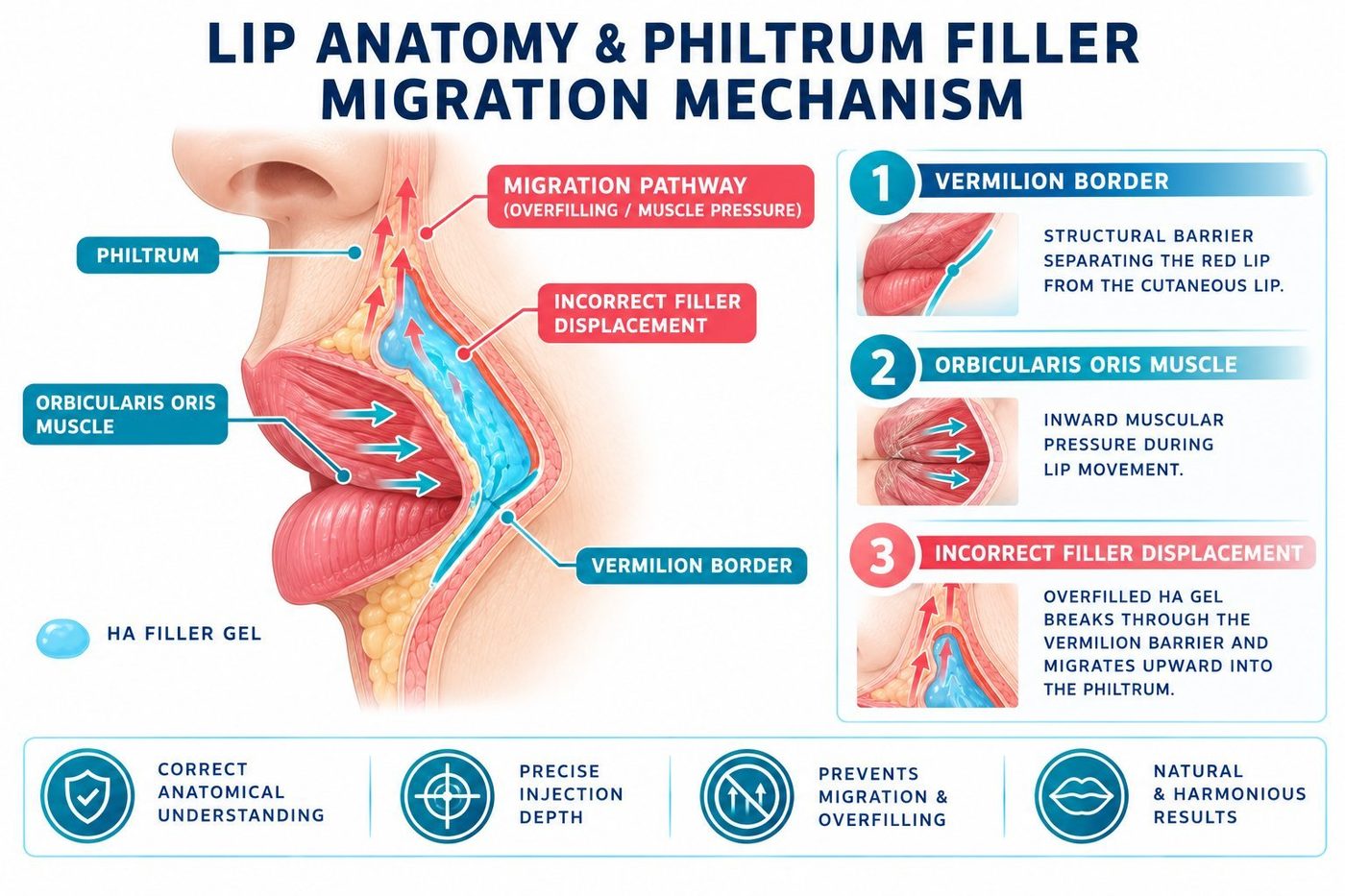
Lip Anatomy and the Mechanism of Filler Migration
Unlike general facial skin, the lips feature an extremely thin epidermis, dense vascularity, and constant dynamic pressure from everyday movements such as drinking through straws, talking, and eating.
Barrier Function of the Vermilion Border: The border demarcating the red lip from the cutaneous upper lip acts as a natural structural barrier preventing filler from migrating upward.
Mechanism of Filler Migration: When excess volume accumulates at this boundary or undergoes mechanical stress, the structural barrier breaks down. Muscle contractions from the orbicularis oris then push filler particles vertically into the lower-resistance subcutaneous layer of the philtrum.
Candidate Assessment (Who Benefits Most?)
May Be Suitable For
- Individuals with thin, asymmetrical lips or ill-defined lip borders that create a flat impression.
- Those looking to lift downturned mouth corners to create a brighter, refreshed smile.
- Patients seeking to smooth fine lip lines for a hydrated, sleek texture.
Requires Prerequisite Treatment For
Patients whose previous lip fillers have already migrated significantly into the philtrum (dissolving existing filler prior to re-injection is mandatory).
4 Primary Causes of Filler Migration into the Philtrum
Overfilling Beyond Capacity
Injecting excessive filler in a single session exceeds the lip's structural capacity, forcing the dense gel to burst into the low-resistance philtrum layer.
Indiscriminate Disruption of the Vermilion Border
Injecting large volumes directly into the lip border to create definition damages the natural border barrier, effectively creating a pathway for filler to leak into the philtrum.
Misplacement into the Orbicularis Oris Muscle Layer
If filler is placed inside the active orbicularis oris muscle instead of the submucosal layer, muscle contractions continuously squeeze and force the gel upward.
Suboptimal Rheological Selection of Filler
Using stiff fillers or formulations with low cohesivity in a highly dynamic area leads to product separation under muscular strain.
High-Risk Technique vs. Precision Injection Technique
| Category | High-Risk Bulk Injection (Bolus) | Ruby Dermatology Micro Precision Method |
|---|---|---|
| Injection Method | Large volumes injected at once (Bolus) | Divided micro-droplet precision delivery |
| Border Management | Overfilling the Vermilion Border | Border barrier preservation & submucosal targeting |
| Filler Rheology | Low cohesivity or overly rigid formulation | HA with high dynamic flexibility & cohesivity |
| Migration Risk | High risk of philtrum spillover & "Donald Duck" lip | Lower risk of philtrum migration; natural-looking volume |
Duration & Hyaluronidase Dissolving Protocol
- Expected Duration: HA fillers designed for lips typically last 6 to 12 months.
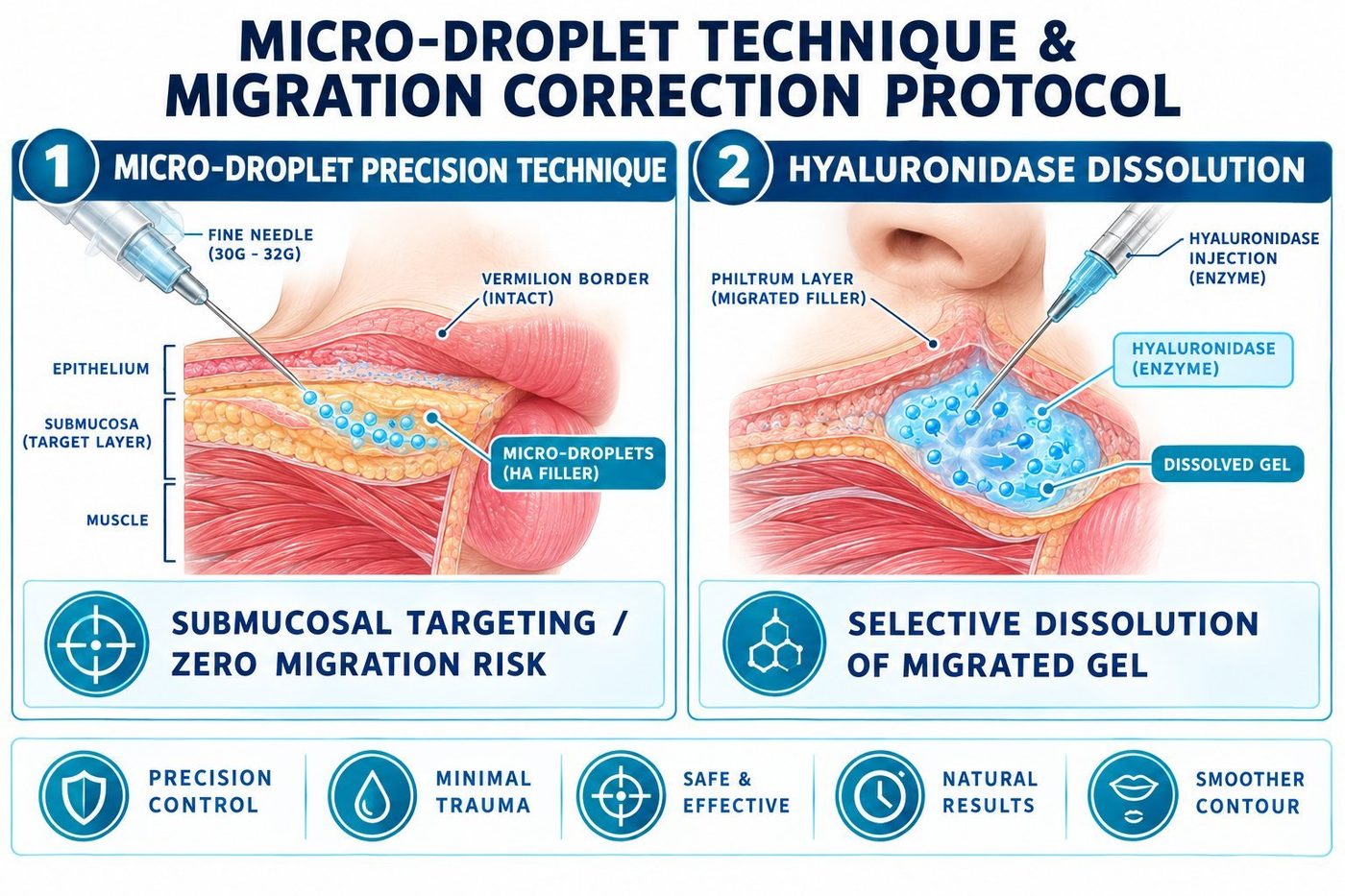
- Correcting Migrated Filler: Migrated gel in the philtrum cannot be repositioned through massage or pressure. Hyaluronidase must be targeted precisely to enzymatically dissolve only the migrated gel; re-treatment can proceed 1 to 2 weeks later following muscular alignment.
Synergistic Treatment Combinations
Lip Filler + Corner-Lifting Botox (DAO Botox)
Administering Botox into the depressor anguli oris (DAO) muscle relaxes down-pulling forces, harmonizing with filler volume to yield a naturally lifted smile line.
Lip Filler + Lip Skinbooster (Rejuran HB Plus / Juvelook)
Combines volumetric enhancement from fillers with mucosal hydration boosters to refine fine surface lines and restore moisture.
Clinical Insights & Practitioner Notes (Doctor HUH Jung)
The cornerstones of successful lip augmentation are 'preserving the border barrier' and applying a 'micro-droplet delivery technique'.
Prior to treatment, I evaluate both static lip anatomy and dynamic movement of the orbicularis oris muscle during smiling or speech. When treating the upper lip, I approach at precise angles to preserve the Vermilion Border integrity and fan micro-droplets evenly across the submucosal layer. Furthermore, selecting hyaluronic acid gels with appropriate cohesivity helps the filler remain in place without migrating, delivering a plump, three-dimensional contour.
Precautions Before & After Treatment
- Avoid Early Manipulation: Refrain from squeezing or aggressively massaging the lips for one week post-treatment while the filler settles.
- Lifestyle Adjustments: For 3 to 5 days, avoid hot foods and activities creating negative pressure or mechanical stress on the lips, such as drinking through straws or smoking.
- Swelling Management: Mild swelling or minor bruising on the day of treatment is normal and resolves within a few days.
This article provides general medical information and does not replace individual diagnosis or treatment. Effects, recovery time and side effects can differ with skin condition and constitution, so please decide on any procedure after consulting a doctor directly.